
 Sign In
  Get Premium
 Easyscape Climate Suitability
The climate suitability sections in Easyscape plant pages show our best estimates for how well each given plant would grow in the climate of your location, along with an estimate for the amount of irrigation for that plant at your location, if any.
Default Climate Requirements
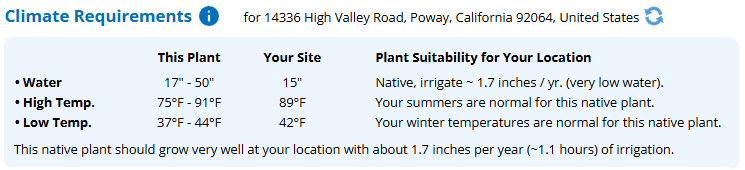
Before entering an address, we show the normal precipitation, high temperature and low temperature ranges on each plant page. So for example, for Coast Live Oak (Quercus agrifolia), we show the following values:

- Plant precipitation shows the range of precipitation amounts each plant receives in its natural environment, defined as 30th-90th native precipitation levels across all native observations.
- Plant high temp shows the “normal” average high temperatures of the hottest month for locations in which this plant has been observed, defined as 10th-90th high temperatures across all observations (native and non-native).
- Plant low temp shows the “normal” average low temperatures of the coldest month of the year for the locations in which this plant has been observed, defined as 20th-90th cold temperatures across all observations (native and non-native).
Personalized Climate Suitability
Once you enter your location, we then estimate how suitable your summer high temperatures and winter low temperatures are for this plant, and how much additional irrigation we estimate this plant will likely require at your location, accounting for your precipitation level and evaporation rates..
See example below again for Coast Live Oak, but now to be grown at a specific address.
Plant Water Requirements
Easyscape’s irrigation estimates are based on the water each plant receives across all the native locations in our database, measured as a percent of the “evapotranspiration” of each location. Evapotranspiration (or Eto) is the measure of the moisture lost from both soil evaporation and plant transpiration at a given location. The amount of water required by a plant as a percentage of the Eto of a given location is typically called its “Plant Factor”. By using Plant Factor analysis, we are able to create personalized plant water requirements for your location.
- For plant species that are non-riparian or rarely riparian, the species Plant Factor is set as the 30th percentile Plant Factor across its native observations.
- For plants that occur in both wetlands and non-wetlands with similar frequency, minimum precipitation is set as 50th percentile the species Plant Factor set as the 50th Plant Factor across its native observations
- .For plants that occur primarily in wetlands but still have significant non-wetland populations, the species Plant Factor is set as the 70th percentile Plant Factor across its native observations.
- For plants that are always or nearly always riparian, we use published Plant Factors, since precipitation alone is not a good estimate of the plant’s water needs. Sources for Plant Factors for fully riparian plants include Water Use Classification of Landscape Species (WUCOLS) Guide, United Nations FAO, the USDA Forest Service and the US Geological Survey (USGS).
- For most plants, the maximum amount of water tolerated by the plant was set as the 90th percentile plant factor for all observations of that plant, whether native, non-native wild, or non-native cultivated.
- Plant factor percentiles were calibrated by comparing estimates to known water requirements for hundreds of plants at locations across multiple climate types.
The "Water" requirement for each plant is then calculated by multiplying the calculated plant factor by the Eto of your location. It shows the estimated amount of water (including both precipitation and supplemental irrigation) each plant would require at your location.
Personalized Irrigation Requirements
Estimated inches of annual irrigation is then calculated by subtracting your normal precipitation from the total water requirement of the plant at your location.
Estimated hours of irrigation per year (assuming a standard 1.5" / 38 mm per hour overhead irrigation spray system) is also provided.
In most cases, for your very low and low water plants, you’ll typically want to provide most or all irrigation during your dry season. For medium, high and very high water plants, you’ll typically want to irrigate throughout the year.
Please note that our irrigation estimates are baseline estimates for the irrigation needed for each plant in your site’s unique climate. To determine your actual irrigation levels, you'll always need to experiment in your own garden, and adjust up or down from the baseline based on the soil, sun, wind, drainage and other conditions of your particular site.
See Easyscape Irrigation Requirements for more information, including how to estimate hours of irrigation required for different watering methods, and tips for adjusting irrigation requirements based on your unique site conditions.
Temperature Suitability Estimates
- If your summer is hotter than the normal range for the plant, or your winter is colder than the normal range for the plant, we warn that this plant might not grow well at your location. For cold temperatures, we’ll also let you know if your winters are OK, borderline OK, borderline too cold, probably too cold, or too cold for each plant.
- If your winters or summers are milder than normal for the plant, we predict that the plant should still grow reasonably well at your location, along with the level of irrigation required to provide the plant with the level of moisture it receives in its natural environment.
- If your summers and winters are in the normal range for this plant, we predict that the plant should grow very well at your location, again with the level of irrigation required to provide the plant with the level of moisture it receives in its natural environment.
Summary Plant Suitability
- The summary at the bottom of the Climate Suitability section estimates overall how well this plant would grow at your location.
- Plants that are native to your location are all considered to grow well at your location, even if they are outside the normal temperature or precipitation ranges for the plant. Depending on the plant’s normal moisture requirements, we may still recommend additional irrigation for native plants. We will almost always recommend additional irrigation for obligate riparian plants, even if they are native to your location.
Climate Matches in Search and Home Pages
When you select “My Climate Matches” in the Easyscape home or search pages, we will only return plant recommendation that we predict will grow at least reasonably well at your location - and specifically where your winter temperature is not too cold for the plant, and your summer temperature is not too hot for the plant.
We show best matches first, where your summer temperatures and winter temperatures are neither hotter nor colder than the normal range for the plant, and where the irrigation required by the plant is “none”, “very low”, or “low” (i.e. < 15” per year).
Overall, we believe it's best to grow plants that are known to grow in areas with summer and winter temperatures that are similar to the conditions in your location, and where irrigation requirements are not excessive.
If you are planning your garden, we recommend choosing plants that need water amounts similar to the precipitation they’ll receive at your location (i.e. your “No”, “Very Low” or “Low” irrigation plants). Those plants will tend to be easier to grow, easier to keep healthy, and easier on the planet!
___________________________________________________________________________
Plant Factor Example
To illustrate Plant Factor percentiles, see example below for Coast Live Oak (Quercus agrifolia). Since Quercus agrifolia is rarely riparian across the heavy majority of its native range, it was assigned a plant factor equal to its 30th percentile observation, or .29.
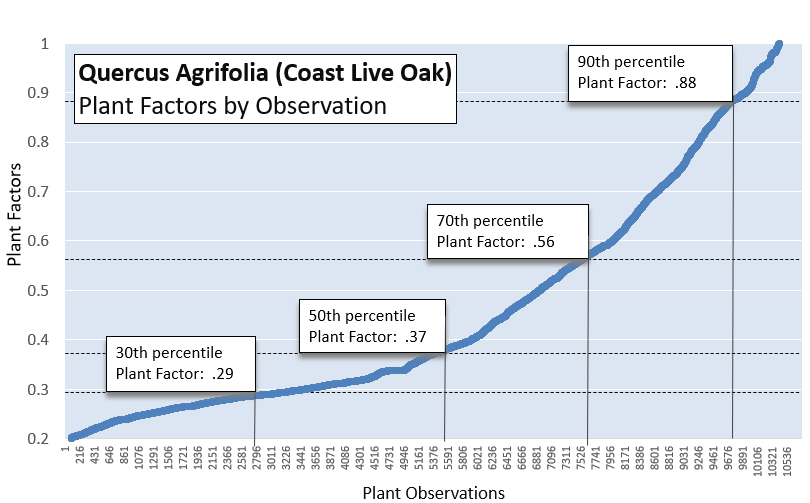
To estimate the rainfall requirement for this plant in Poway, CA with an Eto of 58”, we multiply .29 by 58” to arrive at a 17” total water requirement. To then determine incremental irrigation required, we subtract the 15” normal rainfall of Poway. This gives us an estimated ~2 inches of irrigation required for Quercus agrifolia in Poway for a normal rainfall year, which aligns closely with expert recommendations for this plant at this location.
For more information, please contact us at info@easyscape.com.