
 Sign In
  Get Premium
 Easyscape Irrigation Requirements
Easyscape's irrigation requirements are our best estimate for the optimal amount of irrigation each plant should receive at your location. Estimates are based primarily on the normal rainfall received by the plant in its natural habitat, less the normal amount of rainfall at your location, corrected for your local climate. For more details see Easyscape Irrigation Requirements Methodology shown at the end of this document.
Please note that these are baseline estimates for the irrigation needed for each plant when grown in your site’s unique climate. To determine your actual irrigation levels, you'll always need to experiment in your own garden, and adjust up or down from the baseline based on the soil, sun, wind, drainage and other conditions of your particular site. In most cases, for your very low and low water plants, you’ll want to provide most or all irrigation during your dry season.
Easyscape irrigation search categories correspond to the following irrigation hours and amounts:
Hours Per Year Irrigation Required (assuming a typical 1.5" / 38 mm per hour overhead irrigation spray system)
- None: 0 hours
- Very Low: > 0-5 hours per year
- Low: 5-10 hours per year
- Moderate: 10-20 hours per year
- High: 20-35 hours per year
- Very High: > over 35 hours per year
Inches / mm Per Year Irrigation Required
- None: 0 inches ( 0 mm) per year
- Very Low: 0-7.5 inches ( 0-190 mm ) per year
- Low: 7.5-15 inches ( 190-381 mm ) per year
- Moderate: 15-30 inches ( 381-762 mm ) per year
- High: 30-52 inches ( 762-1333 mm ) per year
- Very High: > 762 inches (1333 mm ) per year
Our irrigation hours/year estimates assume a typical overhead 1.5” per hour spray system. This method most closely mimics natural rainfall, and usually promotes the best root development by encouraging roots to spread outward in search of water.
However, well-placed bubblers or hose watering in bioswales, faux creeks or water-capture basins can be just as effective for larger plants such as trees and shrubs. Their roots will grow out toward the moister zones, much like they would near a seep, creek, or other semi-riparian area in nature.
Bubblers and hoses are generally rated in gallons per minute. To convert from inches of water to total gallons required, use:
Gallons = 0.623 × (inches of water) × (area in ft²)
For example, applying 10 inches of water to a 25 ft² area requires:
0.623 × 10 × 25 = 156 gallons.
Delivering that amount would take about 2.6 hours using a 1 GPM bubbler, or roughly 20 minutes with an 8 GPM hose.
Drip systems are often the best choice for herbs and small subshrubs, particularly in compact planting areas. They are typically rated in gallons per hour (GPH), with 1 GPH being the most common. To apply 10 inches of water to a 1 ft² area, use the formula
Gallons = 0.623 × inches × area (ft²)
So, 0.623 × 10 × 1 = 6.2 gallons.
At 1 GPH, this would take about 6 hours to deliver.
Irrigation Philosophy
Overall, we believe it’s best to plan to provide your plants with the amount of moisture for which they naturally evolved (especially with infrequent deep soaks that mimic their natural rainfall patterns). They'll tend to develop deeper roots, and be healthier, more beautiful, and longer lived than if you provide them with the bare minimum irrigation they need to survive.
Deeper rooted plants will also be more likely to find deeper groundwater, and will often require less or even no irrigation as they mature. So longer term, mimicking nature is often the easiest and most water-efficient strategy, as well as the one that keeps your plants the healthiest.
And if you are planning your garden, we recommend choosing plants that need water levels similar to the precipitation they’ll receive at your location (i.e. your “No”, “Very Low” or “Low” irrigation plants). Those plants will tend to be easier to grow, easier to keep healthy, and easier on the planet!
Adjusting Irrigation Up or Down from Baseline Estimates
See below for some common reasons to adjust these estimates up or down from baseline estimates.
Common Reasons to Decrease Irrigation Amounts
- Deeper and less frequent (i.e. monthly) irrigation schedule. Especially for irrigated trees and shrubs, this is probably the most important factor for saving water over the longer term. Less frequent and deeper irrigation will result in lower soil evaporation rates, and encourage plants to develop deeper root systems. Deep rooted plants will usually require far less or even no irrigation after they are fully established.
- More rainfall than normal. Easyscape estimates are based on 30 year normal precipitation rates for your location, so if any given year has more precipitation than normal, you’ll of course want to decrease your irrigation accordingly.
- Efficient rain capture. If you capture much of your rainfall (i.e. with berms, bioswales or hollows), your plants will need less irrigation. Trees and larger shrubs often send out roots to consistently nearby moist areas, and help distribute the water throughout your garden.
- Presence of nearby water sources (ie seeps or creeks, or even nearby green lawns or other heavily irrigated areas)
- Soils that drain more slowly than normal
- Sites at the bottom of a slope, or on a shallow slope facing away from the sun
- Shaded or partly shaded conditions
- Wind sheltered locations
- Plenty of leaf litter around plants. (Leaf litter is the best mulch. It shades the soil to lower evaporation rates, decomposes into the soil where it helps retain more moisture, and helps build healthy mycorrhizal fungi in the soil.)
- Deeper soils, where deep root development is faster and more likely
- Healthy soils, especially with plenty of carbon and mycorrhizal fungi
- Presence of nearby deep rooted plants. These plants often bring deeper water up to the surface through hydraulic redistribution, and significantly increase moisture retaining soil carbon through fine root turnover.
- Older plants. Under the right conditions, older plants will develop deeper root systems, and will require less or even no artificial irrigation over time.
Common Reasons to Increase Irrigation Amounts
- Frequent, lighter irrigation. Frequent, light irrigation will result in higher evaporation rates and encourage plants to develop shallow root systems.
- Less rainfall than normal
- Excessive rain or irrigation runoff
- Fast draining soils, steep or sunny slopes
- Full sun exposure conditions
- Windy conditions
- Bare soils, with no leaf litter
- Shallow soils, where deep rooting is not possible
- Younger plants, which tend to need more water until they build out their root systems
Easyscape Irrigation Requirements Methodology
Easyscape’s irrigation estimates are based on the water each plant receives in the native locations in which it is observed, measured as a percent of the “evapotranspiration” of each location. Evapotranspiration (or Eto) is the measure of the moisture lost from both soil evaporation and plant transpiration at a given location. The amount of water required by a plant as a percentage of the Eto of a given location is typically called its “Plant Factor”.For plants that are non-riparian or rarely riparian, the species Plant Factor is set as the 30th percentile Plant Factor across its native observations.
- For plants that occur in both wetlands and non-wetlands with similar frequency, minimum precipitation is set as 50th percentile the species Plant Factor set as the 50th Plant Factor across its native observations
- .For plants that occur primarily in wetlands but still have significant non-wetland populations, the species Plant Factor is set as the 70th percentile Plant Factor across its native observations.
- For plants that are always or nearly always riparian, we use published Plant Factors, since precipitation alone is not a good estimate of the plant’s water needs. Sources for Plant Factors for fully riparian plants include Water Use Classification of Landscape Species (WUCOLS) Guide, United Nations FAO, the USDA Forest Service and the US Geological Survey (USGS).
- Plant factor percentiles were calibrated by comparing estimates to known water requirements for hundreds of plants at locations across multiple climate types.
- The Water Requirement for each plant is then calculated by multiplying the calculated plant factor by the Eto of your location. It shows the estimated amount of water (including precipitation and supplemental irrigation) each plant would require at your location.
- Estimated inches of annual irrigation is then calculated by subtracting your normal precipitation from the total water requirement of the plant at your location.
- Plant factor percentiles and overall methodology, was calibrated by comparing irrigation estimates to known irrigation requirements for hundreds of plants at locations across multiple climate types.
- Sources for wetland categorization include the National Wetlands Plantlist, GBIF plant observation notes, map analysis of individual observation locations, and Wikipedia habitat descriptions.
Plant Factor Example
To illustrate Plant Factor percentiles, see example below for Coast Live Oak (Quercus agrifolia). Since Quercus agrifolia is rarely riparian across the heavy majority of its native range, it was assigned a plant factor equal to its 30th percentile observation, or .29.
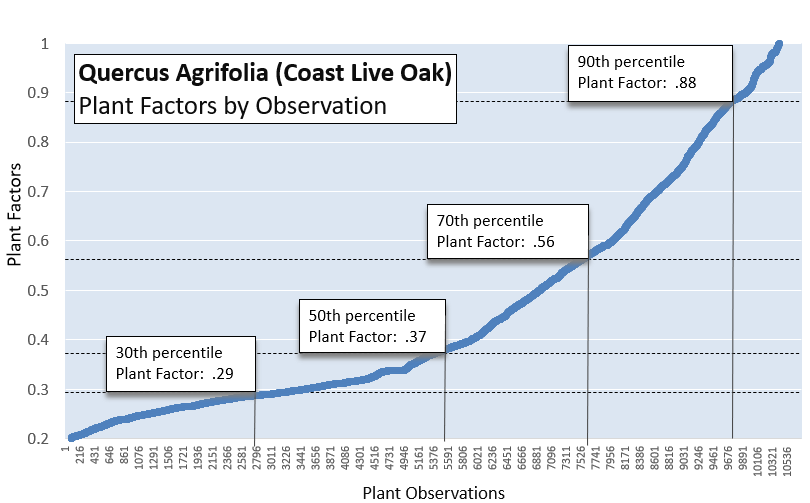
To estimate the rainfall requirement for this plant in Poway, CA with an Eto of 58”, we multiply .29 by 58” to arrive at a 17” total water requirement. To then determine incremental irrigation required, we subtract the 15” normal rainfall of Poway. This gives us an estimated ~2 inches of irrigation required for Quercus agrifolia in Poway for a normal rainfall year, which aligns closely with expert recommendations for this plant at this location.
For more information, please contact us at info@easyscape.com.