Toothache Tree
/
(Zanthoxylum avicennae)
Toothache Tree (Zanthoxylum avicennae)
/


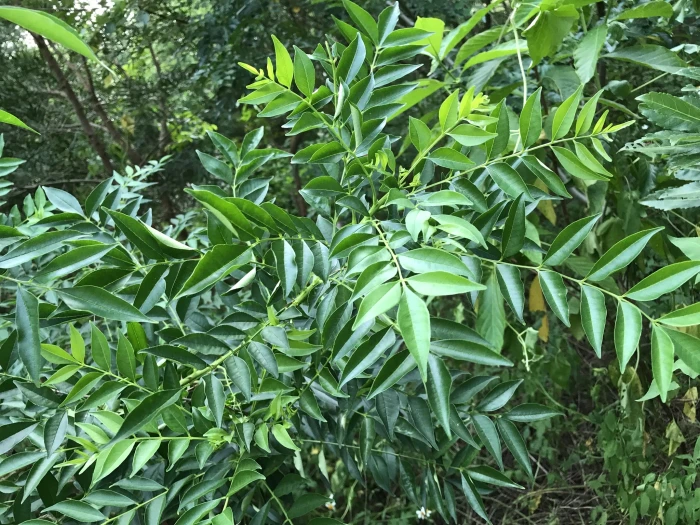

lansan
CC BY 4.0

Image By:
lansan
Recorded By:
Copyright:
CC BY 4.0
Copyright Notice:
Photo by: lansan | License Type: CC BY 4.0 | License URL: http://creativecommons.org/licenses/by/4.0/ | Rights Holder: lansan | Publisher: iNaturalist | Date Created: 2019-09-09T17:35:47-07:00 |



Summary
Ambrosia ambrosioides, commonly known as Canyon Ragweed, is a semi-deciduous shrub or subshrub native to arid desert regions and scrublands of the Southwestern USA and Northwest Mexico. It typically grows to a height of 1–2 meters and is characterized by its elongate, coarsely-toothed leaves that are 4–18 cm long and 1.5–4 cm wide. The plant is monoecious, with both male and female flowers on the same plant; the male (staminate) flowers are arranged in terminal and axillary racemes above the female (pistillate) counterparts. Flowering mainly occurs from February through April, and the plant produces 10–15 mm burs covered with hooked spines that facilitate seed dispersal by attaching to animals and clothing.
Canyon Ragweed is valued for its adaptability to various light conditions, including full sun, part shade, and full shade, making it versatile for different garden settings. It thrives in soils with medium to fast drainage. While not commonly used in ornamental horticulture due to its allergenic pollen, it can be used in naturalistic plantings and restoration projects in its native range. Gardeners should be aware that it can cause allergic reactions in sensitive individuals. CC BY-SA 4.0
Canyon Ragweed is valued for its adaptability to various light conditions, including full sun, part shade, and full shade, making it versatile for different garden settings. It thrives in soils with medium to fast drainage. While not commonly used in ornamental horticulture due to its allergenic pollen, it can be used in naturalistic plantings and restoration projects in its native range. Gardeners should be aware that it can cause allergic reactions in sensitive individuals. CC BY-SA 4.0
Plant Description
- Plant Type: Shrub
- Height: 10-20 feet
- Width: 6-12 feet
- Growth Rate: Moderate
- Flower Color: Green
- Flowering Season: Spring
- Leaf Retention: Deciduous
Growth Requirements
- Sun: Full Sun, Part Shade
- Drainage: Medium
Common Uses
Edible*Disclaimer: Easyscape's listed plant edibility is for informational use. Always verify the safety and proper identification of any plant before consumption.
Natural Habitat
Limestone hills, mixed forests, and riverbanks in southern China, the Philippines, Northern Vietnam, and Taiwan
Other Names
Common Names: Avicenna Prickly Ash
Scientific Names: Zanthoxylum avicennae, Fagara avicennae, Fagara pterota, Nothopanax anisum, Panax anisum, Polyscias anisum, Zanthoxylum avicennae subsp. tonkinense, Zanthoxylum avicennae var. tonkinense, Zanthoxylum avicennae var. touranense
GBIF Accepted Name: Zanthoxylum avicennae