Annual Mullein
/
(Verbascum boerhavii)
Annual Mullein (Verbascum boerhavii)
/


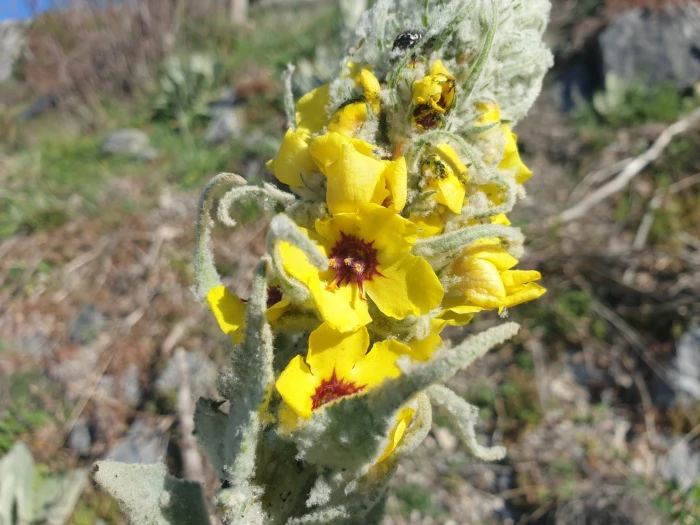

Clément Maouche
CC BY 4.0

Image By:
Clément Maouche
Recorded By:
Copyright:
CC BY 4.0
Copyright Notice:
Photo by: Clément Maouche | License Type: CC BY 4.0 | License URL: http://creativecommons.org/licenses/by/4.0/ | Rights Holder: Clément Maouche | Publisher: iNaturalist | Date Created: 2024-04-14T10:02:16-07:00 |





Summary
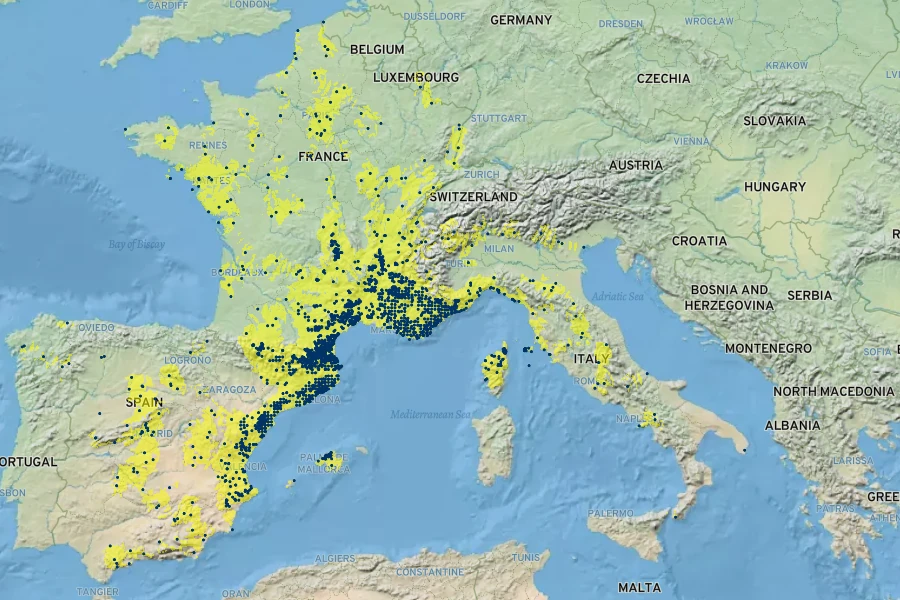
Verbascum boerhavii, commonly known as Annual Mullein, is an annual herb native to the Mediterranean region, specifically Spain, France, Italy, the Balearic Islands, and Corsica. It thrives in open areas such as meadows, roadsides, and disturbed soils, often in calcareous substrates. This species typically grows to a height of 30-60 cm, with a rosette of basal leaves and an erect stem bearing yellow flowers. The flowering season extends from June to September, with flowers arranged in a dense spike inflorescence, providing a modest display. The plant is characterized by its hairy leaves and stems, which can be an irritant to some people.
Annual Mullein is valued for its ease of growth and its traditional use in herbal medicine, particularly for the treatment of hemorrhoids. It is also known for its content of poliumoside, a phenylpropanoid glycoside with potential anti-inflammatory properties. In cultivation, it prefers full sun to partial shade and is tolerant of a range of soil types, provided they are well-drained. While not commonly used in ornamental horticulture, it can be utilized in wildflower gardens or as part of a naturalistic planting scheme. Care should be taken as it can self-seed prolifically and may become weedy in some conditions.CC BY-SA 4.0
Annual Mullein is valued for its ease of growth and its traditional use in herbal medicine, particularly for the treatment of hemorrhoids. It is also known for its content of poliumoside, a phenylpropanoid glycoside with potential anti-inflammatory properties. In cultivation, it prefers full sun to partial shade and is tolerant of a range of soil types, provided they are well-drained. While not commonly used in ornamental horticulture, it can be utilized in wildflower gardens or as part of a naturalistic planting scheme. Care should be taken as it can self-seed prolifically and may become weedy in some conditions.CC BY-SA 4.0
Plant Description
- Plant Type: Herb
- Height: 1.5-3 feet
- Width: 1.5-1.5 feet
- Growth Rate: Moderate
- Flower Color: Yellow
- Flowering Season: Summer
- Leaf Retention: Semi-deciduous
Growth Requirements
- Sun: Full Sun
- Drainage: Fast
Common Uses
Border Plant, Drought Tolerant, Low Maintenance, Rock Garden
Natural Habitat
Native to the Mediterranean region, including Spain, France, Italy, the Balearic Islands, and Corsica, thriving in open areas such as meadows and roadsides
Other Names
Common Names: Mullein
Scientific Names: Verbascum boerhavii, Celsia barnadesii subsp. floccosa, Celsia barnadesii subsp. floccosa, Lychnitis boerhavii, Verbascum bicolor, Verbascum boerhavii f. bicolor, Verbascum boerhavii var. longebracteatum, Verbascum boerhavii var. portae, Verbascum elongatum
GBIF Accepted Name: Verbascum boerhavii