Black False Hellebore
/
(Veratrum nigrum)
Black False Hellebore (Veratrum nigrum)
/



Pavel Komkov
CC BY 4.0

Image By:
Pavel Komkov
Recorded By:
Copyright:
CC BY 4.0
Copyright Notice:
Photo by: Pavel Komkov | License Type: CC BY 4.0 | License URL: http://creativecommons.org/licenses/by/4.0/ | Rights Holder: Pavel Komkov | Publisher: iNaturalist | Date Created: 2022-07-25T17:20:07-07:00 |






Summary
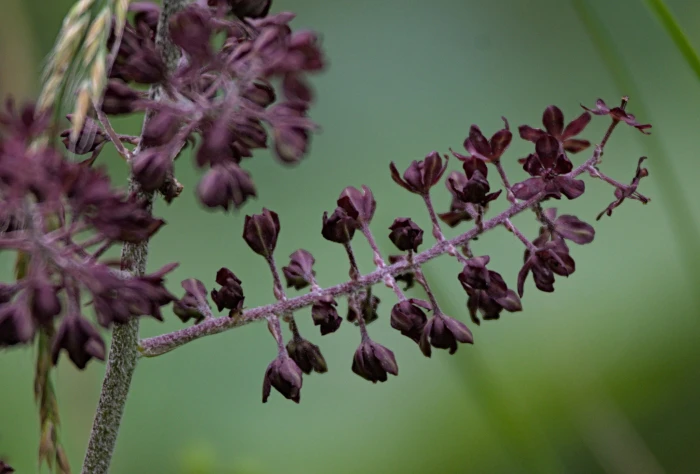
Veratrum nigrum, commonly known as Black False Hellebore, is a perennial herb native to damp meadows, streambanks, and forest clearings across Eurasia, from France to Korea. It can reach up to 4 feet in height and prefers nutrient-rich, moist soils. This plant features broad, pleated, lanceolate leaves that form a sizeable rosette at the base. The flowers are unique, with a deep purple-black color, blooming in erect, branched clusters during early summer. The blooms are not particularly showy but have a certain architectural appeal. After flowering, the plant often goes dormant in response to intense heat.
Black False Hellebore is valued for its striking foliage and unusual flower color, making it a conversation piece in shade gardens and woodland settings. It is also used in traditional medicine, although it is highly toxic and should be handled with care. In cultivation, it requires consistent moisture and does well in partial to full shade, mimicking its natural habitat. It is not drought-tolerant and will need protection from intense afternoon sun. While it is not commonly afflicted by diseases, its toxicity generally keeps pests at bay. Due to its poisonous nature, it should be planted with caution, especially in gardens accessible to children and pets.CC BY-SA 4.0
Black False Hellebore is valued for its striking foliage and unusual flower color, making it a conversation piece in shade gardens and woodland settings. It is also used in traditional medicine, although it is highly toxic and should be handled with care. In cultivation, it requires consistent moisture and does well in partial to full shade, mimicking its natural habitat. It is not drought-tolerant and will need protection from intense afternoon sun. While it is not commonly afflicted by diseases, its toxicity generally keeps pests at bay. Due to its poisonous nature, it should be planted with caution, especially in gardens accessible to children and pets.CC BY-SA 4.0
Plant Description
- Plant Type: Herb
- Height: 4-5 feet
- Width: 2-3 feet
- Growth Rate: Slow
- Flower Color: Green, Purple, Red
- Flowering Season: Summer
- Leaf Retention: Deciduous
Growth Requirements
- Sun: Full Sun, Part Shade
- Drainage: Medium
Common Uses
Border Plant, Deer Resistant, Water Garden
Natural Habitat
Damp meadows, streambanks, and forest clearings across Eurasia
Other Names
Common Names: Black False Hellebore, Black-Hellebore, False Hellebore
Scientific Names: Veratrum nigrum, Helonias nigra, Helonias nigra, Melanthium nigrum, Veratrum bracteatum, Veratrum nigrum subsp. ussuriense, Veratrum nigrum var. microcarpum, Veratrum nigrum var. ussuriense, Veratrum purpureum
GBIF Accepted Name: Veratrum nigrum