Hiba
/
(Thujopsis dolabrata)
Hiba (Thujopsis dolabrata)
/



أبو فريد
PDM 1.0

Image By:
أبو فريد
Recorded By:
Copyright:
PDM 1.0
Copyright Notice:
Photo by: أبو فريد | License Type: PDM 1.0 | License URL: https://creativecommons.org/publicdomain/mark/1.0/ | Uploader: أبو فريد | Publisher: Flickr



Summary
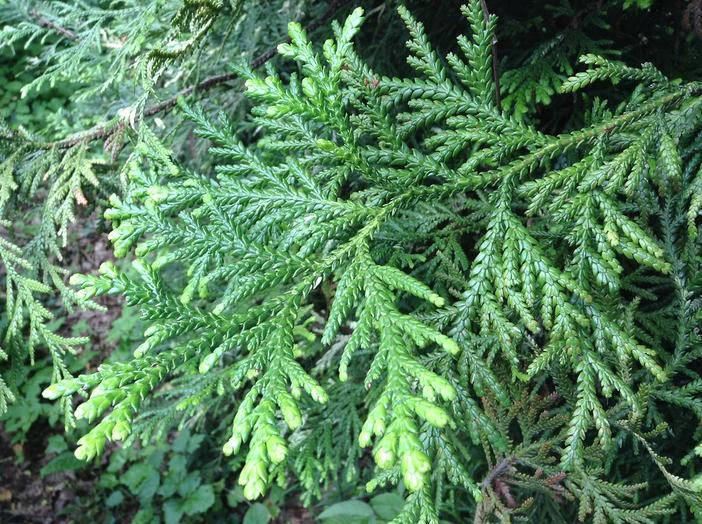
Thujopsis dolabrata, commonly known as Hiba or Hiba Arborvitae, is an evergreen tree native to cool temperate forests, often found in mountainous regions and alongside streams in Japan. It can reach up to 40 meters in height with a trunk diameter of 1.5 meters. The tree’s red-brown bark is notable for peeling in vertical strips, and its dense foliage is comprised of flat sprays of scale-like leaves, which are glossy green above and have distinctive white markings beneath. Thujopsis dolabrata produces small cones, but it is primarily grown for its foliage.
The Hiba Arborvitae is valued for its ornamental qualities, including its striking bark and lush foliage. It is often planted around temples in Japan, signifying its cultural importance, and is also used in gardens and urban landscapes in Europe and North America for its aesthetic appeal. The tree has earned the Royal Horticultural Society’s Award of Garden Merit in the UK, indicating its excellence for garden use. It requires consistently moist soil and is not drought-tolerant, making it suitable for areas with good rainfall or where reliable irrigation is available. It thrives in full sun to part shade and prefers acidic to neutral soils with good drainage. While generally disease-resistant, it can be susceptible to leaf blight and root rot if conditions are too wet.CC BY-SA 4.0
The Hiba Arborvitae is valued for its ornamental qualities, including its striking bark and lush foliage. It is often planted around temples in Japan, signifying its cultural importance, and is also used in gardens and urban landscapes in Europe and North America for its aesthetic appeal. The tree has earned the Royal Horticultural Society’s Award of Garden Merit in the UK, indicating its excellence for garden use. It requires consistently moist soil and is not drought-tolerant, making it suitable for areas with good rainfall or where reliable irrigation is available. It thrives in full sun to part shade and prefers acidic to neutral soils with good drainage. While generally disease-resistant, it can be susceptible to leaf blight and root rot if conditions are too wet.CC BY-SA 4.0
Plant Description
- Plant Type: Tree
- Height: 30-50 feet
- Width: 15-25 feet
- Growth Rate: Slow
- Flower Color: N/A
- Flowering Season: Non-Flowering
- Leaf Retention: Evergreen
Growth Requirements
- Sun: Full Sun
- Drainage: Fast, Medium, Slow
Common Uses
Deer Resistant, Hedges, Low Maintenance, Rock Garden
Natural Habitat
Cool temperate forests, often found in mountainous regions and alongside streams in Japan
Other Names
Common Names: False Arborvitae, Hiba Arborvitae, Hiba Arbor-Vitae, Asunaro, Hiba-Arborvitae, Zeravinec Japonský, Hiba-Lebensbaum, Japanische Zypresse, Tuya De Japón, Hibatuja
Scientific Names: Thujopsis dolobrata, Thujopsis dolabrata, Thujopsis dolabrata var. variegata, Thujopsis dolabrata var. nana, Thuyopsis dolabrata, Thujopsis dolabrata f. nana, Thuja dolobrata, Thujopsis dolabrata f. decumbens, Thujopsis dolabrata f. variegata, Thujopsis dolabrata var. latifolia
GBIF Accepted Name: Thujopsis dolabrata (Thunb. ex L.f.) Siebold & Zucc.