Japanese Thuja
/
(Thuja standishii)
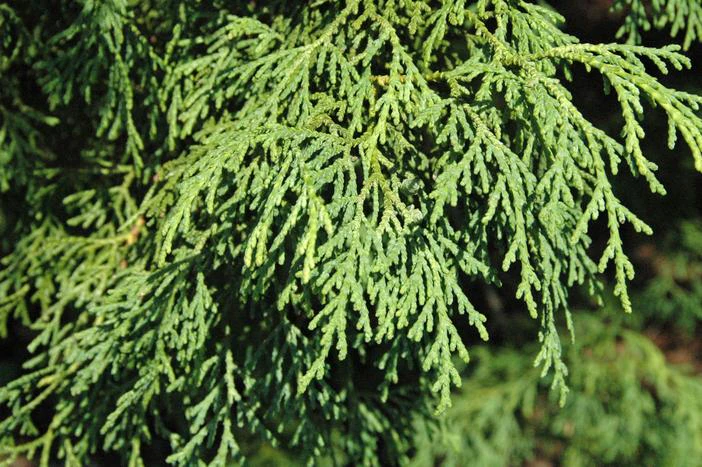
Japanese Thuja (Thuja standishii)
/



James St. John
CC BY 2.0

Image By:
James St. John
Recorded By:
Copyright:
CC BY 2.0
Copyright Notice:
Photo by: James St. John | License Type: CC BY 2.0 | License URL: https://creativecommons.org/licenses/by/2.0 | Uploader: Ser Amantio di Nicolao | Publisher: Wikipedia Commons





Summary
Thuja standishii, commonly known as Japanese Thuja, is an evergreen tree native to mountain forests and often found in riparian zones in Japan. This species is a medium-sized conifer, typically reaching heights of 20–35 meters with a trunk diameter up to 1 meter. Its foliage, which forms in flat sprays, consists of scale-like leaves that are 2–4 mm long, presenting a matte green color on the upper side and narrow white stomatal bands on the underside. The cones are distinctive, starting as oval, yellow-green, and ripening to red-brown, measuring 6–12 mm long and 4–5 mm broad, expanding to 8 mm when open, with 6–10 overlapping scales.
Japanese Thuja is valued for its durable and waterproof wood, which emits an attractive scent, making it a significant timber tree in Japan. In cultivation, it is used for ornamental purposes, including urban planting, and as a specimen tree in large gardens. It is appreciated for its ease of maintenance and the textural quality of its foliage. Japanese Thuja requires full sun to part shade and well-drained soils for optimal growth. While it is not known for serious pest or disease problems, it can suffer from root rot if planted in poorly drained soils.CC BY-SA 4.0
Japanese Thuja is valued for its durable and waterproof wood, which emits an attractive scent, making it a significant timber tree in Japan. In cultivation, it is used for ornamental purposes, including urban planting, and as a specimen tree in large gardens. It is appreciated for its ease of maintenance and the textural quality of its foliage. Japanese Thuja requires full sun to part shade and well-drained soils for optimal growth. While it is not known for serious pest or disease problems, it can suffer from root rot if planted in poorly drained soils.CC BY-SA 4.0
Plant Description
- Plant Type: Tree
- Height: 20-30 feet
- Width: 10-15 feet
- Growth Rate: Moderate
- Flower Color: N/A
- Flowering Season: Non-Flowering
- Leaf Retention: Evergreen
Growth Requirements
- Sun: Full Sun, Part Shade
- Drainage: Medium
Common Uses
Bird Garden, Butterfly Garden, Fragrant, Hedges, Low Maintenance
Natural Habitat
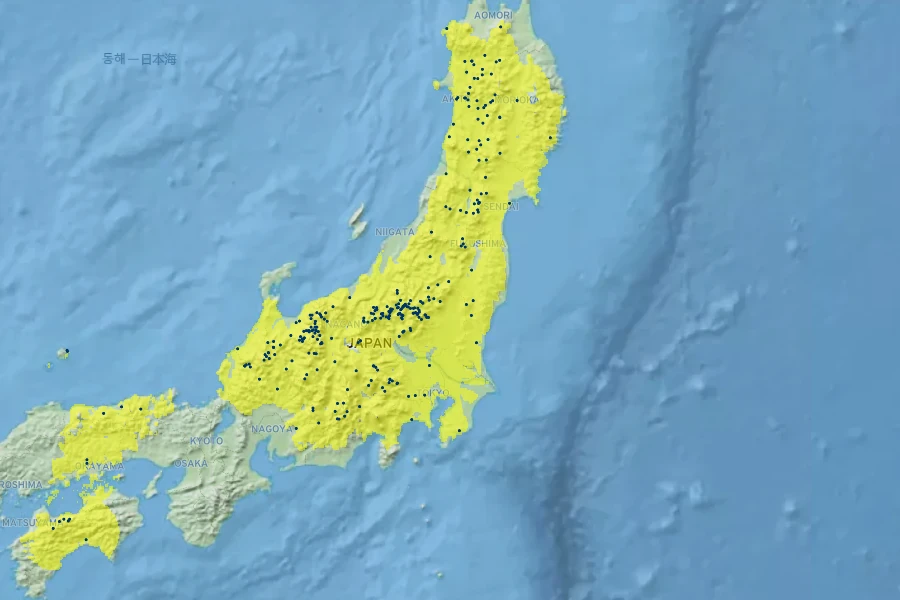
Mountain forests and riparian zones in Japan
Other Names
Common Names: Japanese Arbor-Vitae, Japanese Arborvitae, Japanischer Lebensbaum, Thuya Du Japon, Japán Életfa, Tuia Del Giappone, Japanse Levensboom, Туя Стэндиша (Tuya Stzndisha), Japansk Tuja, 日本香柏 (Ri Ben Xiang Bai)
Scientific Names: Thuja standishii, Thuja japonica, Thujopsis standishii, Thuja gigantea var. japonica
GBIF Accepted Name: Thuja standishii (Gordon) Carrière