Bog Bulrush
/
(Schoenoplectiella mucronata)
Bog Bulrush (Schoenoplectiella mucronata)
/



Cheng-Tao Lin
CC BY 4.0

Image By:
Cheng-Tao Lin
Recorded By:
Copyright:
CC BY 4.0
Copyright Notice:
Photo by: Cheng-Tao Lin | License Type: CC BY 4.0 | License URL: http://creativecommons.org/licenses/by/4.0/ | Rights Holder: Cheng-Tao Lin | Publisher: iNaturalist | Date Created: 2014-08-21T14:18:33-07:00 |





Summary
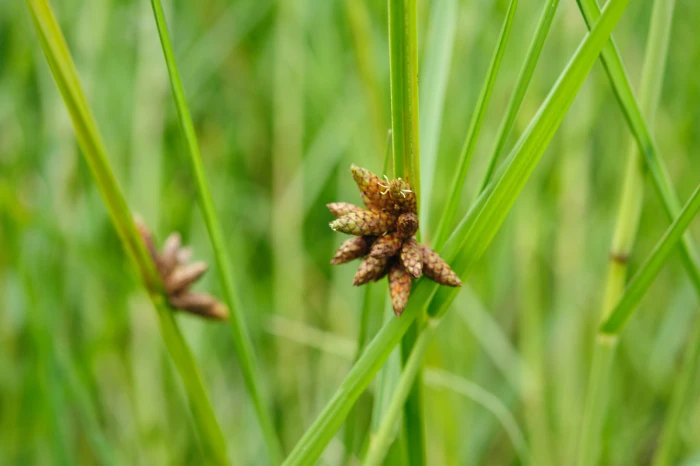
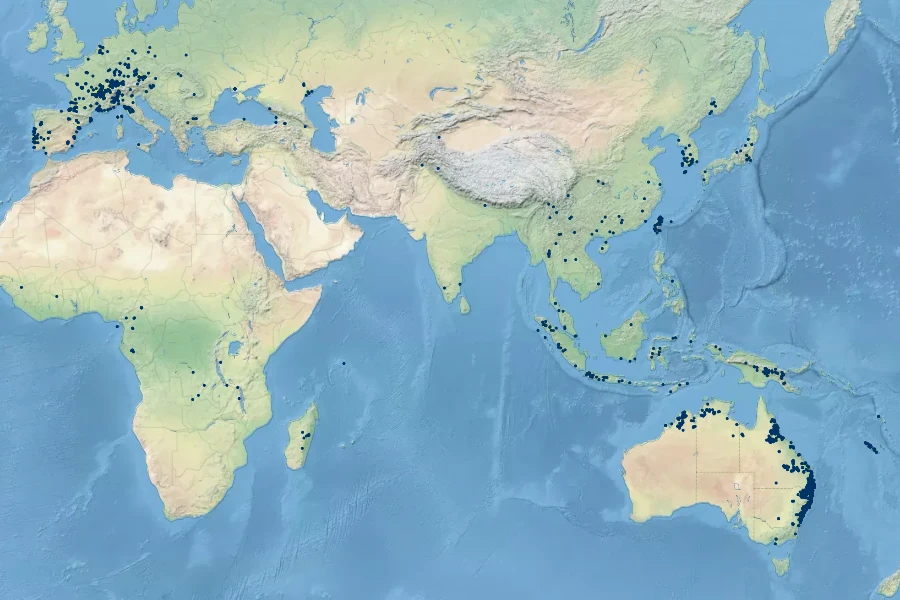
Schoenoplectiella mucronata, commonly known as Bog Bulrush, is a perennial herb that thrives in a variety of wetland habitats, including marshes, wet meadows, pond margins, and along streams and rivers. It is native to a wide range stretching from Eurasia to Africa and Australia. The plant typically grows up to 3.3 feet tall, forming dense clumps of erect, three-angled stems. The inflorescences are brownish, with spikelets arranged in clusters, and are less conspicuous than the foliage. Bog Bulrush blooms in the summer, and while the flowers are not particularly showy, they are critical for wetland ecosystems.
Bog Bulrush is valued for its role in soil stabilization and water filtration in its native habitats. It is often used in constructed wetlands for wastewater treatment and in riparian restoration projects. In cultivation, it requires consistently moist to wet soil conditions and can grow in full sun to part shade. While it is not typically grown for ornamental purposes, it can be used in water gardens or naturalized areas. Care should be taken as it can spread in rice fields, as seen in California, where it is considered a weed. It has a robust root system that can spread, so management may be necessary to control its growth in certain areas.CC BY-SA 4.0
Bog Bulrush is valued for its role in soil stabilization and water filtration in its native habitats. It is often used in constructed wetlands for wastewater treatment and in riparian restoration projects. In cultivation, it requires consistently moist to wet soil conditions and can grow in full sun to part shade. While it is not typically grown for ornamental purposes, it can be used in water gardens or naturalized areas. Care should be taken as it can spread in rice fields, as seen in California, where it is considered a weed. It has a robust root system that can spread, so management may be necessary to control its growth in certain areas.CC BY-SA 4.0
Plant Description
- Plant Type: Grass
- Height: 1.5-3.5 feet
- Width: 1-2 feet
- Growth Rate: Moderate
- Flower Color: N/A
- Flowering Season: Summer
- Leaf Retention: Deciduous
Growth Requirements
- Sun: Full Sun, Part Shade
- Drainage: Standing, Slow
Common Uses
Erosion Control, Low Maintenance, Water Garden
Natural Habitat
Marshes, wet meadows, pond margins, and along streams and rivers
Other Names
Common Names: Roughseed Bulrush, Awlfruit Bulrush, Ricefield Bulrush
Scientific Names: Schoenoplectiella mucronata, Heleophylax mucronatus, Hymenochaeta preslii, Isolepis mucronata, Schoenoplectiella mucronata f. brevisetacea, Schoenoplectiella mucronata var. ishizawae, Schoenoplectiella mucronata var. ishizawii, Schoenoplectiella mucronata var. tatarana, Schoenoplectus javanus
GBIF Accepted Name: Schoenoplectiella mucronata