Black-Eyed Susan
/
(Rudbeckia hirta var. pulcherrima)
Black-Eyed Susan (Rudbeckia hirta var. pulcherrima)
/


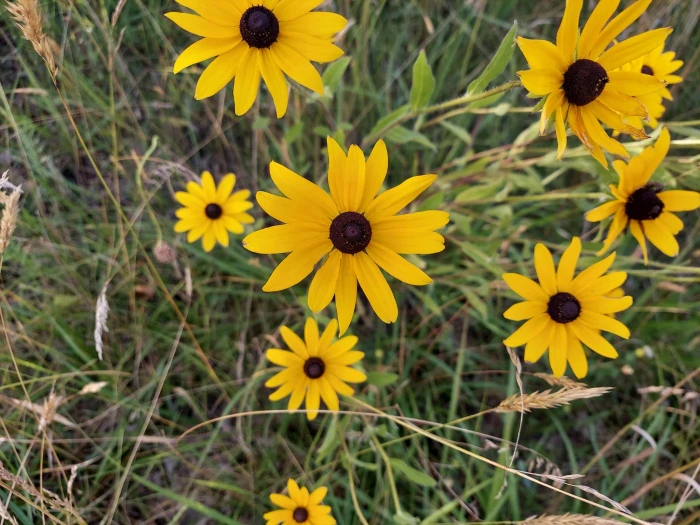

the swamp ass
CC BY 4.0

Image By:
the swamp ass
Recorded By:
Copyright:
CC BY 4.0
Copyright Notice:
Photo by: the swamp ass | License Type: CC BY 4.0 | License URL: http://creativecommons.org/licenses/by/4.0/ | Rights Holder: the swamp ass | Publisher: iNaturalist | Date Created: 2021-07-03T18:35:46-07:00 |



Summary
Rudbeckia hirta var. pulcherrima, commonly known as Weedy Black-eyed Susan, is a versatile plant that can be an annual, biennial, or short-lived perennial herb. It is native to open woodlands, prairies, fields, and roadsides across the Central and Eastern USA and Southern Canada. This plant typically grows to a height of 1-3 feet (0.3-0.9 meters) and a width of 2-3 feet (0.6-0.9 meters). Weedy Black-eyed Susan has a clumping form with lance-shaped leaves, and it is renowned for its daisy-like flowers with a prominent, dark brown central cone surrounded by bright yellow to orange petals. The flowers bloom profusely from midsummer to early fall and are highly attractive to pollinators.
Weedy Black-eyed Susan is valued for its ease of maintenance and its ability to thrive in a variety of conditions, making it a popular choice for wildflower gardens, borders, and naturalized areas. It is also used for cut flowers due to its long vase life. In cultivation, it prefers full sun to part shade and adapts well to soils with fast drainage, though it can tolerate clay soils. It is relatively pest-free but can be susceptible to powdery mildew in humid conditions.CC BY-SA 4.0
Weedy Black-eyed Susan is valued for its ease of maintenance and its ability to thrive in a variety of conditions, making it a popular choice for wildflower gardens, borders, and naturalized areas. It is also used for cut flowers due to its long vase life. In cultivation, it prefers full sun to part shade and adapts well to soils with fast drainage, though it can tolerate clay soils. It is relatively pest-free but can be susceptible to powdery mildew in humid conditions.CC BY-SA 4.0
Plant Description
- Plant Type: Herb
- Height: 1-3 feet
- Width: 1.5-3 feet
- Growth Rate: Moderate
- Flower Color: Yellow
- Flowering Season: Summer, Fall
- Leaf Retention: Deciduous
Growth Requirements
- Sun: Full Sun, Part Shade
- Drainage: Fast
Common Uses
Bee Garden, Bird Garden, Butterfly Garden, Deer Resistant, Drought Tolerant, Hummingbird Garden, Low Maintenance, Rabbit Resistant, Showy Flowers, Street Planting
Natural Habitat
Native to open woodlands, prairies, fields, and roadsides
Other Names
Common Names: Pinewoods Coneflower, Black-Eyed Susan, Sommarrudbeckia
Scientific Names: Brown-eyed Susan
GBIF Accepted Name: Rudbeckia hirta var. pulcherrima Farw.