Marsh Labrador Tea
/
(Rhododendron tomentosum)
Marsh Labrador Tea (Rhododendron tomentosum)
/



Oleg Kosterin
CC BY 4.0

Image By:
Oleg Kosterin
Recorded By:
Copyright:
CC BY 4.0
Copyright Notice:
Photo by: Oleg Kosterin | License Type: CC BY 4.0 | License URL: http://creativecommons.org/licenses/by/4.0/ | Rights Holder: Oleg Kosterin | Publisher: iNaturalist | Date Created: 2022-06-25T09:35:57-07:00 |






Summary
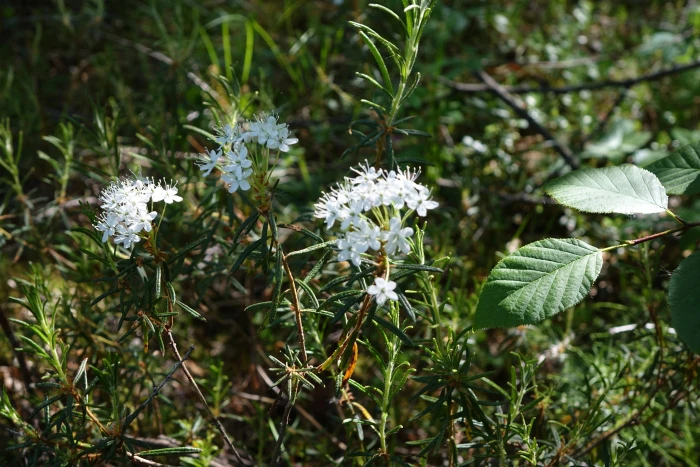
Rhododendron tomentosum, commonly known as marsh Labrador tea or wild rosemary, is an evergreen shrub native to boreal forests, peat bogs, and wetlands across northern latitudes in North America, Europe, and Asia. It typically reaches up to 20 inches (50 cm) in height and is characterized by its leathery, evergreen leaves that are woolly beneath, and its small, white to pale pink flowers that bloom in late spring to early summer. The flowers are arranged in tight clusters and are modest in appearance, yet they are attractive to pollinators such as bees. The plant’s bark is not particularly notable, but it does produce small, hard capsules as fruit.
Marsh Labrador tea is valued for its hardiness and ability to thrive in acidic, peaty soils where other plants may struggle. It is often used in restoration projects for wetland habitats and can be planted in bog gardens or as part of a native plant landscape. It requires consistently moist soil conditions and can tolerate partial shade, though it prefers full sun. While it has been traditionally used for its herbal properties and as a natural insect deterrent, caution is advised due to the presence of toxic terpenes. Gardeners should handle the plant with care and avoid ingesting any part of it.CC BY-SA 4.0
Marsh Labrador tea is valued for its hardiness and ability to thrive in acidic, peaty soils where other plants may struggle. It is often used in restoration projects for wetland habitats and can be planted in bog gardens or as part of a native plant landscape. It requires consistently moist soil conditions and can tolerate partial shade, though it prefers full sun. While it has been traditionally used for its herbal properties and as a natural insect deterrent, caution is advised due to the presence of toxic terpenes. Gardeners should handle the plant with care and avoid ingesting any part of it.CC BY-SA 4.0
Plant Description
- Plant Type: Shrub
- Height: 1.5-3 feet
- Width: 1.5-3 feet
- Growth Rate: Slow
- Flower Color: White
- Flowering Season: Summer
- Leaf Retention: Evergreen
Growth Requirements
- Sun: Full Sun, Part Shade
- Drainage: Medium, Slow
Common Uses
Border Plant, Low Maintenance, Showy Flowers, Water Garden
Natural Habitat
Boreal forests, peat bogs, and wetlands
Other Names
Common Names: Northern Labrador Tea, Wild Rosemary, Crystal Tea, Marsh Ledum, Guotz-Râse
Scientific Names: Rhododendron tomentosum, Ledum decumbens, Ledum decumbens, Ledum dilatatum, Ledum graveolens, Ledum groenlandicum f. denudatum, Ledum maximum, Ledum palustre, Ledum palustre f. decumbens
GBIF Accepted Name: Rhododendron tomentosum