Red Mangrove
/
(Rhizophora mangle)
Red Mangrove (Rhizophora mangle)
/


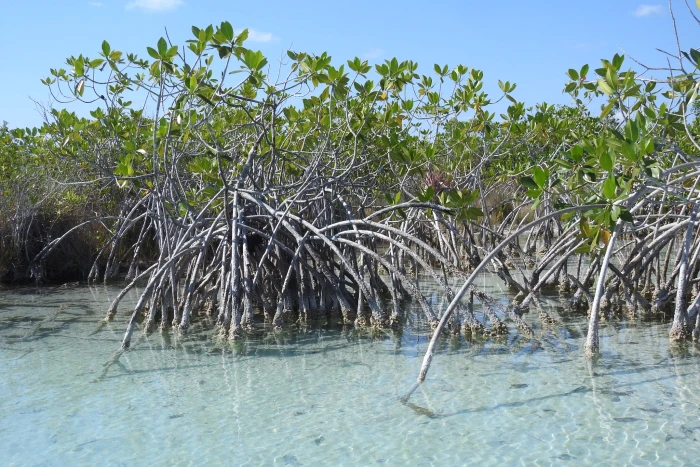

Luis Mora
CC BY 4.0

Image By:
Luis Mora
Recorded By:
Copyright:
CC BY 4.0
Copyright Notice:
Photo by: Luis Mora | License Type: CC BY 4.0 | License URL: http://creativecommons.org/licenses/by/4.0/ | Rights Holder: Luis Mora | Publisher: iNaturalist | Date Created: 2019-03-29T10:01:25-07:00 |



Summary
Rhizophora mangle, commonly known as the red mangrove, is a perennial tree native to mangrove swamps in tropical and subtropical regions of the world, including the Atlantic and Pacific coasts of the Americas, West Africa, and parts of the Indo-Pacific. It typically grows to 20 ft (6.1 m) in cultivation, but can reach heights up to 80 ft (24 m) in ideal conditions. The red mangrove is characterized by its thick, grey-brown bark and robust root system, which stabilizes shorelines and reduces erosion. Its leaves are elliptical, 1–2 in (2.5–5.1 cm) wide and 3–5 in (7.6–12.7 cm) long, with a darker green color on the top than on the bottom. Yellow flowers bloom in the spring, followed by distinctive propagules that drop into the water and take root elsewhere.
The red mangrove is valued for its ecological role in coastal environments, providing critical habitat for a variety of wildlife, including fish, birds, and crocodiles. It is also appreciated for its ability to filter pollutants and stabilize shorelines, making it an important species for conservation efforts. In cultivation, it is used in aquatic and riparian restoration projects. It thrives in full sun and requires high amounts of water, tolerating a range of soil drainage conditions. It is invasive in Hawaii and other Pacific islands, forming dense mangrove thickets that displace local wetland species.CC BY-SA 4.0
The red mangrove is valued for its ecological role in coastal environments, providing critical habitat for a variety of wildlife, including fish, birds, and crocodiles. It is also appreciated for its ability to filter pollutants and stabilize shorelines, making it an important species for conservation efforts. In cultivation, it is used in aquatic and riparian restoration projects. It thrives in full sun and requires high amounts of water, tolerating a range of soil drainage conditions. It is invasive in Hawaii and other Pacific islands, forming dense mangrove thickets that displace local wetland species.CC BY-SA 4.0
Plant Description
- Plant Type: Tree, Shrub
- Height: 15-35 feet
- Width: 15-40 feet
- Growth Rate: Moderate
- Flower Color: N/A
- Flowering Season: Spring, Summer, Fall, Winter
- Leaf Retention: Evergreen
Growth Requirements
- Sun: Full Sun
- Drainage: Slow, Medium, Fast
Common Uses
Bird Garden, Butterfly Garden, Erosion Control, Low Maintenance, Salt Tolerant, Water Garden
Natural Habitat
Mangrove swamps in tropical and subtropical regions of the world
Other Names
Common Names: American Mangrove, Mangrove, Mangle, Mangle Colorado, Mangle Rojo, Mangue Vermelho, Mangue-Vermelho, Amerikansk Mangrove, Cunapo, Mangle De Chifle, Mangle Zapatero
Scientific Names: Rhizophora mangle, Rhizophora americana
GBIF Accepted Name: Rhizophora mangle L.