Pretty Buttercup
/
(Ranunculus pulchellus)
Pretty Buttercup (Ranunculus pulchellus)
/



© Edmundas Greimas
CC BY 4.0

Image By:
© Edmundas Greimas
Recorded By:
Copyright:
CC BY 4.0
Copyright Notice:
Photo by: © Edmundas Greimas | License Type: CC BY 4.0 | License URL: http://creativecommons.org/licenses/by/4.0/ | Uploader: grey_moss | Publisher: iNaturalist |






Summary
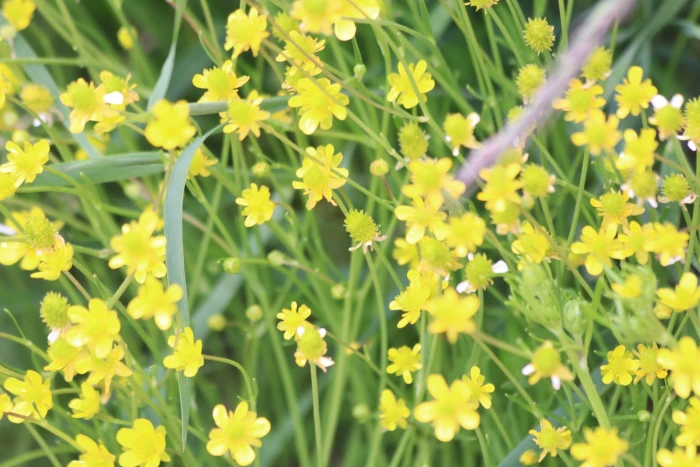
Ranunculus pulchellus, commonly known as Pretty Buttercup or Beautiful Buttercup, is a perennial herbaceous plant native to moist meadows, forest clearings, and stream banks across Asia. It thrives in a variety of soil types, including clay, which is often rich in nutrients and retains moisture. This species exhibits a moderate growth rate, reaching heights of 0.5-1.5 feet (0.15-0.5 meters) and spreading 0.5-1 feet (0.2-0.3 meters). The Pretty Buttercup is characterized by its glossy, yellow, cup-shaped flowers that bloom profusely in the spring and summer, adding a splash of color to garden settings.
The showy flowers of Ranunculus pulchellus make it a desirable plant for ornamental gardens, borders, and as a ground cover in moist areas. Its preference for full sun to part shade and adaptable nature to medium draining clay or loam soils make it a versatile choice for gardeners. While it requires medium amounts of water, it is important to avoid waterlogged conditions to prevent root rot. The Pretty Buttercup is relatively low maintenance, but it can be susceptible to pests such as aphids and fungal diseases in overly humid conditions. Gardeners should also be aware that all parts of the plant are toxic if ingested, so caution should be exercised if planted in areas accessible to children or pets.CC BY-SA 4.0
The showy flowers of Ranunculus pulchellus make it a desirable plant for ornamental gardens, borders, and as a ground cover in moist areas. Its preference for full sun to part shade and adaptable nature to medium draining clay or loam soils make it a versatile choice for gardeners. While it requires medium amounts of water, it is important to avoid waterlogged conditions to prevent root rot. The Pretty Buttercup is relatively low maintenance, but it can be susceptible to pests such as aphids and fungal diseases in overly humid conditions. Gardeners should also be aware that all parts of the plant are toxic if ingested, so caution should be exercised if planted in areas accessible to children or pets.CC BY-SA 4.0
Plant Description
- Plant Type: Herb
- Height: 0.5-1.5 feet
- Width: 0.5-1 feet
- Growth Rate: Moderate
- Flower Color: Yellow
- Flowering Season: Spring, Summer
- Leaf Retention: Deciduous
Growth Requirements
- Sun: Full Sun, Part Shade
- Drainage: Medium
Common Uses
Border Plant, Butterfly Garden, Low Maintenance, Water Garden
Natural Habitat
Moist meadows, forest clearings, and stream banks across Asia
Other Names
Common Names: Beautiful Buttercup
Scientific Names: Ranunculus pulchellus, Ranunculus flammula, Ranunculus gaurii, Ranunculus lingua var. subvillosus, Ranunculus longicaulis subsp. pulchellus, Ranunculus longicaulis var. pulchellus, Ranunculus macrodon, Ranunculus macrodon, Ranunculus moorcroftianus, Ranunculus pulchellus
GBIF Accepted Name: Ranunculus pulchellus