Arctic Buttercup
/
(Ranunculus arcticus)
Arctic Buttercup (Ranunculus arcticus)
/


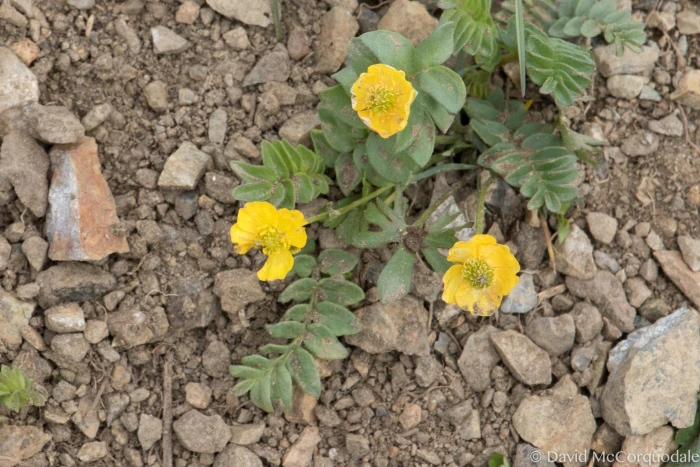

David McCorquodale
CC BY 4.0

Image By:
David McCorquodale
Recorded By:
Copyright:
CC BY 4.0
Copyright Notice:
Photo by: David McCorquodale | License Type: CC BY 4.0 | License URL: http://creativecommons.org/licenses/by/4.0/ | Rights Holder: David McCorquodale | Publisher: iNaturalist | Date Created: 2017-06-24T15:17:38-07:00 |



Summary
Ranunculus arcticus, commonly known as Arctic Buttercup or Birdfoot Buttercup, is a perennial herb that is part of the buttercup family. It is native to alpine and arctic regions, where it inhabits tundra, gravelly areas, and rocky outcrops, often in moist but well-drained soils. This species is adapted to cold climates across the circumpolar regions of Northern Europe, Northern Asia, and North America. It typically grows to about 10 inches tall and is characterized by a basal rosette of leaves and erect flowering stems. The bright yellow, radially symmetrical flowers are showy and bloom singly or in small cymes during the short arctic summer.
The Arctic Buttercup is valued for its bright yellow flowers, which can add a splash of color to rock gardens and alpine collections. It is relatively low-maintenance, requiring minimal care once established in a suitable location. In cultivation, it prefers full sun to partial shade and thrives in dry, well-drained soils, particularly those that are neutral to alkaline. While not commonly used in large-scale landscaping, it is appreciated by enthusiasts of alpine plants and can serve as an interesting specimen in specialized gardens. Care should be taken to avoid overly wet conditions, as this can lead to root rot.CC BY-SA 4.0
The Arctic Buttercup is valued for its bright yellow flowers, which can add a splash of color to rock gardens and alpine collections. It is relatively low-maintenance, requiring minimal care once established in a suitable location. In cultivation, it prefers full sun to partial shade and thrives in dry, well-drained soils, particularly those that are neutral to alkaline. While not commonly used in large-scale landscaping, it is appreciated by enthusiasts of alpine plants and can serve as an interesting specimen in specialized gardens. Care should be taken to avoid overly wet conditions, as this can lead to root rot.CC BY-SA 4.0
Plant Description
- Plant Type: Grass, Herb
- Height: 0.1-0.5 feet
- Width: 0.1-0.5 feet
- Growth Rate: Moderate
- Flower Color: Yellow
- Flowering Season: Summer
- Leaf Retention: Deciduous
Growth Requirements
- Sun: Full Sun
- Drainage: Medium, Fast
Common Uses
Bird Garden, Low Maintenance
Natural Habitat
Native to alpine and arctic regions, including tundra and rocky areas
Other Names
Common Names: Arctic Buttercup, Bird’s-Foot Buttercup, Arctic Crowfoot
Scientific Names: Ranunculus arcticus, Ranunculus affinis, Ranunculus affinis f. macrocalyx, Ranunculus affinis f. microcalyx, Ranunculus affinis subsp. wilanderi, Ranunculus affinis var. apetalus, Ranunculus affinis var. lasiocarpus, Ranunculus affinis var. leiocarpus, Ranunculus affinis var. subintegrifolius
GBIF Accepted Name: Ranunculus arcticus