Tipa Colorado
/
(Pterogyne nitens)
Tipa Colorado (Pterogyne nitens)
/


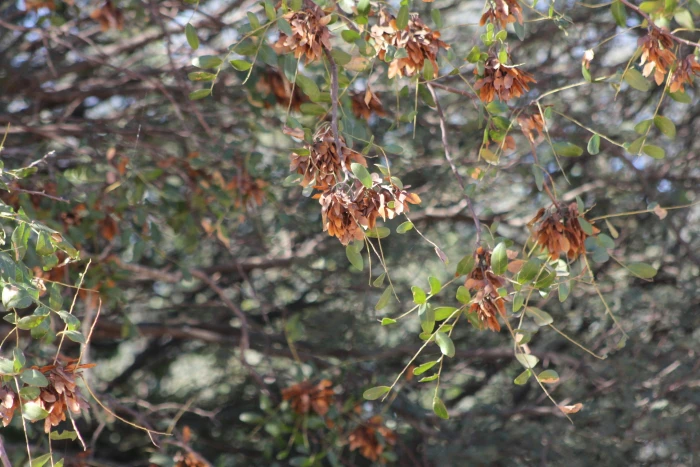

Romi Galeota Lencina
CC BY 4.0

Image By:
Romi Galeota Lencina
Recorded By:
Copyright:
CC BY 4.0
Copyright Notice:
Photo by: Romi Galeota Lencina | License Type: CC BY 4.0 | License URL: http://creativecommons.org/licenses/by/4.0/ | Rights Holder: Romi Galeota Lencina | Publisher: iNaturalist | Date Created: 2023-06-18T12:19:37-07:00 |



Summary
Pterogyne nitens, commonly known as Tipa Colorado in Spanish and Amendoim Bravo in Portuguese, is a deciduous tree native to the interior Atlantic Forest and Gran Chaco region, which includes parts of Brazil, Paraguay, Bolivia, and Argentina. It is the only species in the monotypic genus Pterogyne within the legume family, Fabaceae. This species typically grows to a height of 20-30 meters with a trunk diameter of up to 1 meter. Pterogyne nitens has a straight, cylindrical trunk with a dense, rounded canopy. It produces small, inconspicuous greenish-white flowers during the spring and summer months, followed by distinctive winged seed pods that are initially green and turn reddish-brown as they mature.
The tree is valued for its hard, reddish timber, which is used in carpentry and construction. In cultivation, Pterogyne nitens is appreciated for its shade and ornamental qualities, including its attractive foliage that turns yellow before shedding. It is suitable for urban planting, large gardens, and as a street tree. The tree prefers full sun to partial shade, requires moderate water, and thrives in well-drained soils. While it is not particularly prone to diseases, it can be susceptible to pests such as borers and caterpillars. Gardeners should check local regulations before planting when grown outside its native range.CC BY-SA 4.0
The tree is valued for its hard, reddish timber, which is used in carpentry and construction. In cultivation, Pterogyne nitens is appreciated for its shade and ornamental qualities, including its attractive foliage that turns yellow before shedding. It is suitable for urban planting, large gardens, and as a street tree. The tree prefers full sun to partial shade, requires moderate water, and thrives in well-drained soils. While it is not particularly prone to diseases, it can be susceptible to pests such as borers and caterpillars. Gardeners should check local regulations before planting when grown outside its native range.CC BY-SA 4.0
Plant Description
- Plant Type: Tree
- Height: 25-50 feet
- Width: 25-50 feet
- Growth Rate: Rapid
- Flower Color: Yellow
- Flowering Season: Summer
- Leaf Retention: Evergreen
Growth Requirements
- Sun: Full Sun
- Drainage: Medium, Fast
Common Uses
Erosion Control, Showy Flowers
Natural Habitat
Interior Atlantic Forest and Gran Chaco region
Other Names
Common Names: Tipuana, Pride of Bolivia, Tipa, Tipilla, Yellow Jacaranda
Scientific Names: Pterogyne nitens, Machaerium pseudotipe, Pterogyne nitens f. parvifolia
GBIF Accepted Name: Pterogyne nitens