Autumn Squill
/
(Prospero autumnale)
Autumn Squill (Prospero autumnale)
/


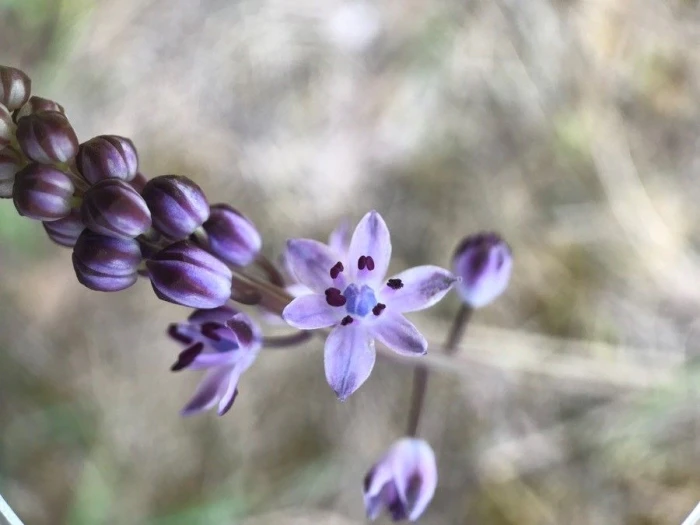

lyl razin
CC BY-SA 4.0

Image By:
lyl razin
Recorded By:
Copyright:
CC BY-SA 4.0
Copyright Notice:
Photo by: lyl razin | License Type: CC BY-SA 4.0 | License URL: https://creativecommons.org/licenses/by-sa/4.0/ | Attribution: lyl razin (cc-by-sa) | Rights Holder: lyl razin | Publisher: PlantNet | Date Created: 2019-08-12T16:49:46.503Z | Title: Prospero autumnale (L.) Speta: flower | Notes: Prospero autumnale (L.) Speta: flower |





Summary
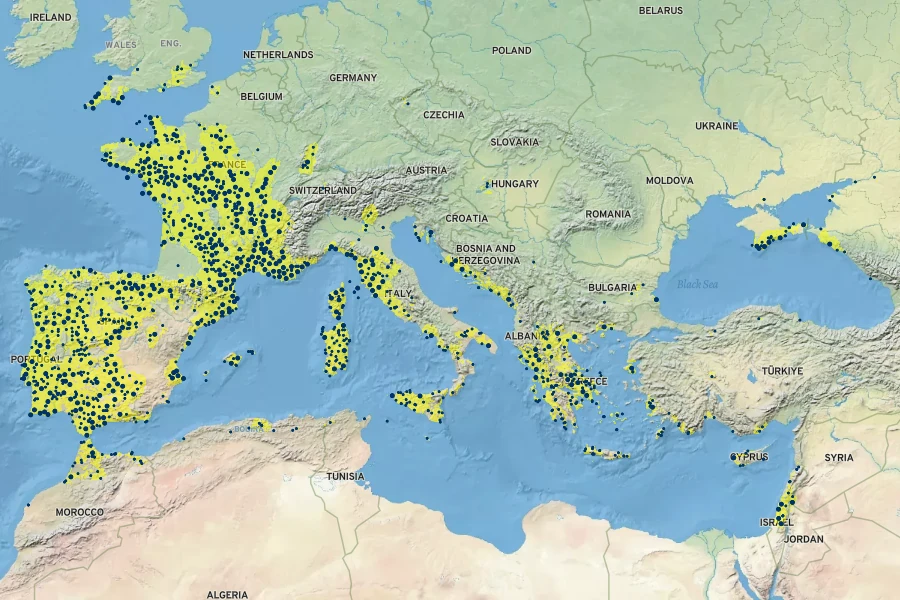
Prospero autumnale, commonly known as Autumn Squill, is a deciduous perennial bulb that is native to a variety of habitats including rocky slopes, open woodlands, and grasslands in the Mediterranean Region. It is a small plant, typically growing to a height of 0.2-0.5 feet (0.06-0.15 meters) and spreading 0.2-0.3 feet (0.06-0.09 meters) wide. The Autumn Squill has a delicate appearance, with slender stems and narrow leaves. It produces small, bell-shaped purple flowers in late summer to fall, which are moderately showy and add a splash of color to the landscape.
Autumn Squill is valued for its ability to naturalize and provide late-season blooms. It is often used in rock gardens, borders, and as underplanting for larger shrubs or trees. This bulbous plant is relatively low maintenance and thrives in well-drained soils. It prefers full sun to part shade, which allows for greater flexibility in garden design. While generally disease-free, it can be susceptible to bulb rot if planted in overly wet conditions. Autumn Squill is not known for aggressive roots or significant pest problems, making it a reliable choice for many garden settings.CC BY-SA 4.0
Autumn Squill is valued for its ability to naturalize and provide late-season blooms. It is often used in rock gardens, borders, and as underplanting for larger shrubs or trees. This bulbous plant is relatively low maintenance and thrives in well-drained soils. It prefers full sun to part shade, which allows for greater flexibility in garden design. While generally disease-free, it can be susceptible to bulb rot if planted in overly wet conditions. Autumn Squill is not known for aggressive roots or significant pest problems, making it a reliable choice for many garden settings.CC BY-SA 4.0
Plant Description
- Plant Type: Bulb
- Height: 0.2-0.5 feet
- Width: 0.2-0.3 feet
- Growth Rate: Moderate
- Flower Color: Purple, Pink
- Flowering Season: Summer, Fall
- Leaf Retention: Deciduous
Growth Requirements
- Sun: Full Sun, Part Shade
- Drainage: Medium
Common Uses
Low Maintenance, Rock Garden, Showy Flowers
Natural Habitat
Rocky slopes, open woodlands, and grasslands in the Mediterranean Region
Other Names
Common Names: Starry Hyacinth
Scientific Names: Prospero autumnale, Scilla autumnalis, Prospero pulchellum, Scilla pulchella, Scilla autumnalis var. autumnalis, Scilla holzmannia, Scilla racemosa, Ornithogalum autumnale, Scilla autumnalis subsp. latifolia
GBIF Accepted Name: Prospero autumnale (L.) Speta