Australian Cheesewood
/
(Pittosporum undulatum)
Australian Cheesewood (Pittosporum undulatum)
/



Hinnerk11
CC BY-SA 4.0

Image By:
Hinnerk11
Recorded By:
Copyright:
CC BY-SA 4.0
Copyright Notice:
Photo by: Hinnerk11 | License Type: CC BY-SA 4.0 | License URL: https://creativecommons.org/licenses/by-sa/4.0 | Uploader: Hinnerk11 | Publisher: Wikimedia Commons | Title: Pittosporum_undulatum_(Hanbury_Gardens).jpg | Notes: == {{int:filedesc}} == {{Information |Description=The Morton Arboretum (West Side) in Lisle, Illinois. |Source=[https://www.flickr.com/photos/50352333@N06/4642152243/ Jacob's Ladder, Greek Valerian (Polemonium reptans) with spider] |Date=2003-05-10 1






Summary
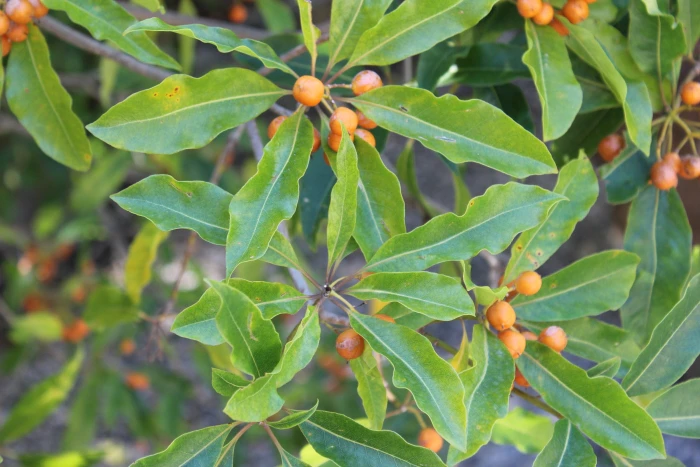
Pittosporum undulatum, commonly known as Australian Cheesewood, is an evergreen tree or large shrub native to rainforests, coastal forests, and sheltered valleys in Southeastern Australia. It typically grows to a height of 15 meters (49 feet) with a dense, rounded canopy. The glossy, dark green leaves are lance-shaped with wavy margins, and the plant produces small, fragrant, creamy-white flowers in late spring to early summer. These flowers are followed by conspicuous orange woody fruits about 1 cm in diameter, which persist for several months. The bark is light gray and becomes furrowed with age.
Australian Cheesewood is appreciated for its fragrant flowers, attractive foliage, and ability to provide dense screening. It is used in urban landscapes, as a hedge or screen, and occasionally as a specimen tree. It prefers well-drained soils, tolerates a range of soil types, and can grow in full sun to part shade. Gardeners should be aware that it can become invasive outside its native range due to its prolific seed production and adaptability to various environments. It is invasive in South Africa, Brazil, the Azores, Hawaii, and parts of Australia, dominating forests and outcompeting native trees.CC BY-SA 4.0
Australian Cheesewood is appreciated for its fragrant flowers, attractive foliage, and ability to provide dense screening. It is used in urban landscapes, as a hedge or screen, and occasionally as a specimen tree. It prefers well-drained soils, tolerates a range of soil types, and can grow in full sun to part shade. Gardeners should be aware that it can become invasive outside its native range due to its prolific seed production and adaptability to various environments. It is invasive in South Africa, Brazil, the Azores, Hawaii, and parts of Australia, dominating forests and outcompeting native trees.CC BY-SA 4.0
Plant Description
- Plant Type: Tree, Shrub
- Height: 30-50 feet
- Width: 30-40 feet
- Growth Rate: Rapid
- Flower Color: White
- Flowering Season: Spring
- Leaf Retention: Evergreen
Growth Requirements
- Sun: Full Sun, Part Shade
- Drainage: Slow, Medium
Common Uses
Bee Garden, Fragrant, Hedges
Natural Habitat
Rainforests, coastal forests, and sheltered valleys in Southeastern Australia
Other Names
Common Names: Krusig Glansbuske
Scientific Names: Pittosporum undulatum
GBIF Accepted Name: Pittosporum undulatum Vent.