Western Bladderpod
/
(Physaria occidentalis)
Western Bladderpod (Physaria occidentalis)
/


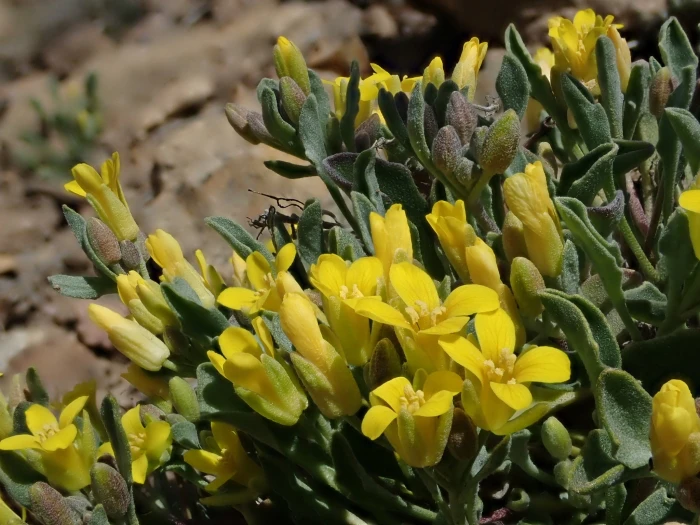

© Nolan Exe
CC BY 4.0

Image By:
© Nolan Exe
Recorded By:
Copyright:
CC BY 4.0
Copyright Notice:
Photo by: © Nolan Exe | License Type: CC BY 4.0 | License URL: http://creativecommons.org/licenses/by/4.0/ | Uploader: fern_friend | Publisher: iNaturalist |





Summary
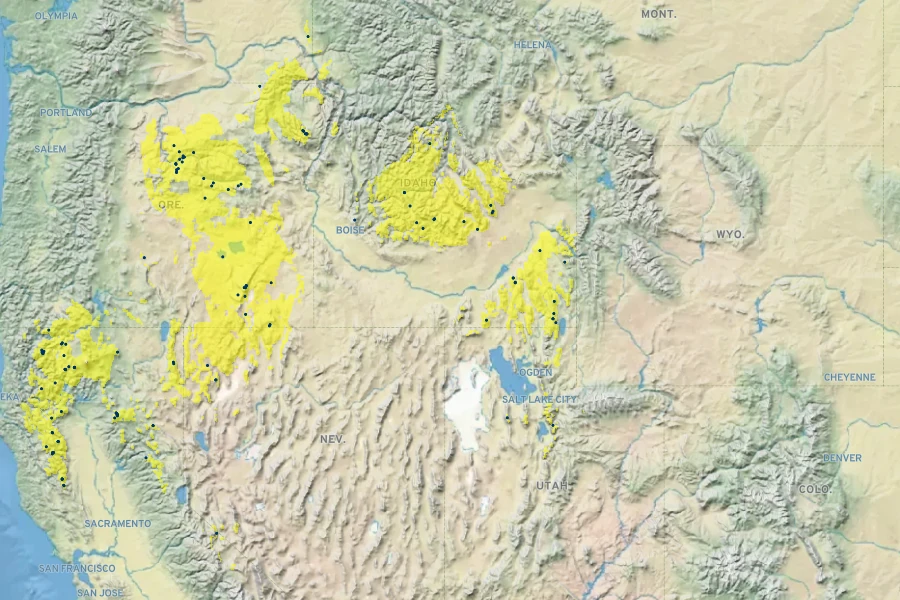
Physaria occidentalis, commonly known as Western Bladderpod or Western Twinpod, is a perennial herb that is native to the arid and semi-arid regions of Western North America, particularly in shrublands, grasslands, and open rocky slopes. It has a moderate growth rate and typically reaches a height and width of 0.5-1.5 feet (0.15-0.45 meters). The plant forms a low, mounded clump with silvery-green foliage. Its bright yellow, four-petaled flowers bloom in the spring and are quite showy, attracting pollinators such as bees and butterflies.
Western Bladderpod is valued for its drought tolerance and ability to thrive in poor soils, making it a suitable choice for xeriscaping and rock gardens. It is also used in restoration projects to stabilize soils and promote biodiversity. The plant requires minimal maintenance once established and is resistant to most pests and diseases. It is best grown in full sun and well-drained sandy or loamy soils, with low water needs once established. While it is not typically grown for its culinary or medicinal properties, it is appreciated for its ornamental value and its role in supporting native pollinators.CC BY-SA 4.0
Western Bladderpod is valued for its drought tolerance and ability to thrive in poor soils, making it a suitable choice for xeriscaping and rock gardens. It is also used in restoration projects to stabilize soils and promote biodiversity. The plant requires minimal maintenance once established and is resistant to most pests and diseases. It is best grown in full sun and well-drained sandy or loamy soils, with low water needs once established. While it is not typically grown for its culinary or medicinal properties, it is appreciated for its ornamental value and its role in supporting native pollinators.CC BY-SA 4.0
Plant Description
- Plant Type: Herb
- Height: 0.5-1.5 feet
- Width: 0.5-1.5 feet
- Growth Rate: Moderate
- Flower Color: Yellow
- Flowering Season: Spring
- Leaf Retention: Deciduous
Growth Requirements
- Sun: Full Sun
- Drainage: Medium, Fast
Common Uses
Drought Tolerant, Low Maintenance, Rock Garden
Natural Habitat
Native to arid and semi-arid regions of Western North America, particularly in shrublands, grasslands, and open rocky slopes
Other Names
Common Names: Western Twinpod
Scientific Names: Physaria occidentalis, Lesquerella occidentalis, Lesquerella occidentalis subsp. occidentalis, Physaria occidentalis var. occidentalis, Vesicaria occidentalis
GBIF Accepted Name: Physaria occidentalis