Broad Beechfern
/
(Phegopteris hexagonoptera)
Broad Beechfern (Phegopteris hexagonoptera)
/


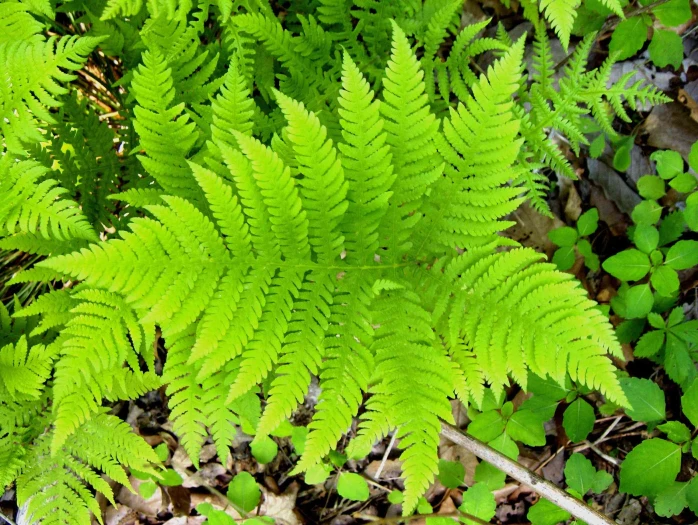

Jaknouse Wikipedia
Public domain

Image By:
Jaknouse Wikipedia
Recorded By:
Copyright:
Public domain
Copyright Notice:
Photo by: Jaknouse Wikipedia | License Type: Public domain | License URL: https://creativecommons.org/public-domain/ | Uploader: File Upload Bot (Magnus Manske) | Publisher: Wikimedia Commons | Title: Phegopteris_hexagonoptera1.JPG | Notes: {{Information |Description ={{la|1=''Phlomis fruticosa''}} {{fr|1=[[:fr:Sauge de Jérusalem|Sauge de Jérusalem]]}} {{en|1=[[:w:Phlomis fruticosa|Jerusalem Sage]]}} {{de|1=[[:de:Strauchiges Brandkraut|Strauchiges Brandkraut]]}} {{sv|1=[





Summary
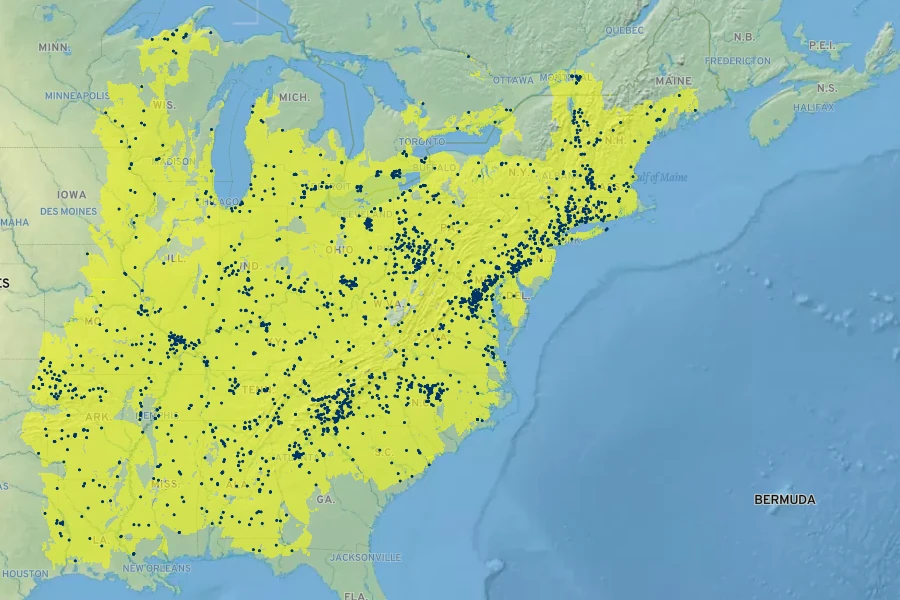
Phegopteris hexagonoptera, commonly known as Broad Beechfern, is a perennial herbaceous fern native to rich, deciduous forests and shaded, moist areas in the eastern United States and adjacent regions of Ontario. It typically forms clumps of broadly triangular fronds from a creeping rootstock, reaching a height of 18-24 inches (45-60 cm). The fronds are compound with a somewhat hexagonal outline, giving the species its name. Broad Beechfern is appreciated for its lush, green foliage that adds texture to shaded garden areas.
Broad Beechfern is valued for its ability to adapt to garden conditions, creating a naturalistic ground cover in shaded landscapes. It is often used in woodland gardens, shade gardens, and naturalized areas. This fern thrives under a canopy of trees, mimicking its native habitat. It requires consistently moist soil and benefits from a layer of organic mulch to retain soil moisture. While it is relatively low-maintenance, it does not tolerate dry conditions well. Broad Beechfern is not known for serious disease or pest issues, making it a reliable choice for gardeners seeking a fern with minimal problems.CC BY-SA 4.0
Broad Beechfern is valued for its ability to adapt to garden conditions, creating a naturalistic ground cover in shaded landscapes. It is often used in woodland gardens, shade gardens, and naturalized areas. This fern thrives under a canopy of trees, mimicking its native habitat. It requires consistently moist soil and benefits from a layer of organic mulch to retain soil moisture. While it is relatively low-maintenance, it does not tolerate dry conditions well. Broad Beechfern is not known for serious disease or pest issues, making it a reliable choice for gardeners seeking a fern with minimal problems.CC BY-SA 4.0
Plant Description
- Plant Type: Fern
- Height: 1.5-2 feet
- Width: 1.5-2 feet
- Growth Rate: Moderate
- Flower Color: N/A
- Flowering Season: Non-Flowering
- Leaf Retention: Deciduous
Growth Requirements
- Sun: Part Shade, Full Shade
- Drainage: Medium
Common Uses
Border Plant, Deer Resistant, Low Maintenance, Rabbit Resistant
Natural Habitat
Rich, deciduous forests and shaded, moist areas in the eastern United States and adjacent regions of Ontario
Other Names
Common Names: Broad Beech Fern, Southern Beech Fern, Phégoptère À Hexagones, Phégoptéride À Hexagones, Thélyptère À Hexagones
Scientific Names: Phegopteris hexagonoptera, Thelypteris hexagonoptera, Dryopteris hexagonoptera, Polypodium hexagonopterum, Phegopteris hexagonoptera f. ternata, Dryopteris hexagonoptera f. furcata, Dryopteris hexagonoptera f. simonsii, Lastrea hexagonoptera, Nephrodium hexagonopterum, Polypodium cicutarium
GBIF Accepted Name: Phegopteris hexagonoptera (Michx.) Fée