Sudetic Lousewort
/
(Pedicularis sudetica)
Sudetic Lousewort (Pedicularis sudetica)
/


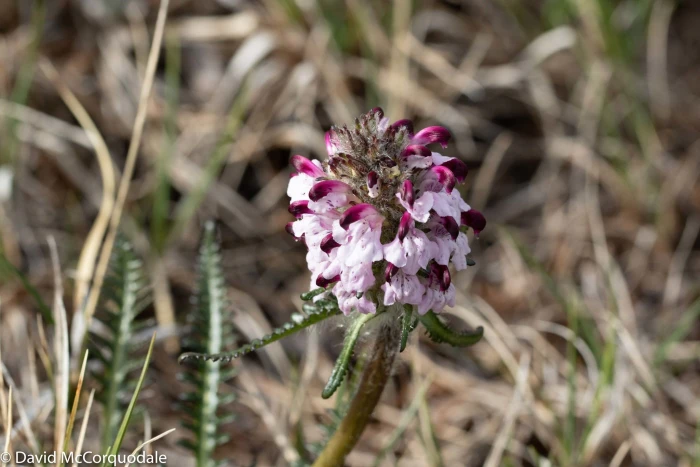

© David McCorquodale
CC BY 4.0

Image By:
© David McCorquodale
Recorded By:
Copyright:
CC BY 4.0
Copyright Notice:
Photo by: © David McCorquodale | License Type: CC BY 4.0 | License URL: http://creativecommons.org/licenses/by/4.0/ | Uploader: dbmcc09 | Publisher: iNaturalist |



Summary
Pedicularis sudetica, commonly known as Sudetic Lousewort, is a perennial herb native to alpine and subalpine meadows, as well as moist, grassy slopes of Northern Europe, Subarctic Asia, and North America. It has also been introduced to parts of North America, including Alaska, Colorado, New Mexico, Wyoming, and Canada. Sudetic Lousewort typically grows to about 1 foot in height and features hermaphroditic flowers that are adapted to its native high-altitude habitats.
This plant is characterized by its fern-like leaves and dense clusters of yellow to pinkish-purple flowers that bloom in the summer. The flowers are tubular and hooded, which are attractive to pollinators such as bees. In cultivation, Sudetic Lousewort is valued for its unique foliage and flowers, which add interest to rock gardens, alpine collections, and naturalized areas. It prefers moist, well-drained soils and can tolerate partial shade, although it thrives in full sun. While not commonly found in cultivation, it can be a conversation piece in a specialized garden setting. Sudetic Lousewort requires consistent moisture and cool conditions to mimic its native alpine environment. It is not known for significant pest or disease problems, but its specialized habitat requirements can make it challenging to grow in lower elevations or warmer climates. There are no widely known cultivars of this species in the horticultural trade.CC BY-SA 4.0
This plant is characterized by its fern-like leaves and dense clusters of yellow to pinkish-purple flowers that bloom in the summer. The flowers are tubular and hooded, which are attractive to pollinators such as bees. In cultivation, Sudetic Lousewort is valued for its unique foliage and flowers, which add interest to rock gardens, alpine collections, and naturalized areas. It prefers moist, well-drained soils and can tolerate partial shade, although it thrives in full sun. While not commonly found in cultivation, it can be a conversation piece in a specialized garden setting. Sudetic Lousewort requires consistent moisture and cool conditions to mimic its native alpine environment. It is not known for significant pest or disease problems, but its specialized habitat requirements can make it challenging to grow in lower elevations or warmer climates. There are no widely known cultivars of this species in the horticultural trade.CC BY-SA 4.0
Plant Description
- Plant Type: Herb
- Height: 1-3 feet
- Width: 0.5-1 feet
- Growth Rate: Moderate
- Flower Color: Pink, Purple, Red, White
- Flowering Season: Summer
- Leaf Retention: Deciduous
Growth Requirements
- Sun: Full Sun, Part Shade
- Drainage: Medium
Common Uses
Border Plant, Butterfly Garden, Low Maintenance, Water Garden
Natural Habitat
Alpine and subalpine meadows, as well as moist, grassy slopes
Other Names
Common Names: Sudetic Lousewort, Fernweed
Scientific Names: Pedicularis sudetica, Pedicularis comosa, Pedicularis discolor, Pedicularis discolor, Pedicularis eriostachys, Pedicularis eriostachys, Pedicularis hirsuta, Pedicularis incarnata, Pedicularis lasiostachys, Pedicularis nasuta
GBIF Accepted Name: Pedicularis sudetica