Hartweg’s Doll’s-Lily
/
(Odontostomum hartwegii)
Hartweg’s Doll’s-Lily (Odontostomum hartwegii)
/


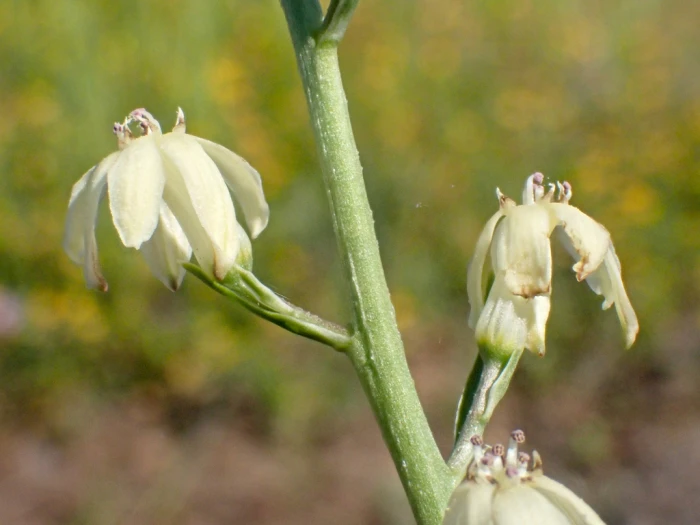

Chloe and Trevor Van Loon
CC BY 4.0

Image By:
Chloe and Trevor Van Loon
Recorded By:
Copyright:
CC BY 4.0
Copyright Notice:
Photo by: Chloe and Trevor Van Loon | License Type: CC BY 4.0 | License URL: http://creativecommons.org/licenses/by/4.0/ | Rights Holder: Chloe and Trevor Van Loon | Publisher: iNaturalist | Date Created: 2021-04-03T08:54:28-07:00 |



Summary
Odontostomum hartwegii, commonly known as Hartweg’s doll’s-lily, is a perennial herb endemic to the inner coastal mountain ranges and Sierra Nevada foothills of northern California. It is particularly adapted to rocky clay and serpentine soils, often flourishing in areas with vernal pools, which are temporary pools of water that provide habitat for distinctive plants and animals. The plant grows from an oval-shaped corm and produces a curving, widely branching stem that can reach up to 20 inches tall. The white or yellowish flowers, which have six tepals, are showy and arranged in racemes or panicles, blooming from late winter to early spring.
Hartweg’s doll’s-lily is valued for its unique and attractive flowers, which can add interest to rock gardens or native plant collections. It is not commonly used in general landscape cultivation due to its specific habitat requirements and rarity. This species requires well-drained soils and can tolerate periods of drought once established, reflecting its adaptation to the Mediterranean climate of its native region. It prefers full sun to partial shade conditions. While not widely available, it can be propagated by seed or division of corms. There are no major disease issues, but its specialized habitat needs can make it challenging to grow outside of its native range.CC BY-SA 4.0
Hartweg’s doll’s-lily is valued for its unique and attractive flowers, which can add interest to rock gardens or native plant collections. It is not commonly used in general landscape cultivation due to its specific habitat requirements and rarity. This species requires well-drained soils and can tolerate periods of drought once established, reflecting its adaptation to the Mediterranean climate of its native region. It prefers full sun to partial shade conditions. While not widely available, it can be propagated by seed or division of corms. There are no major disease issues, but its specialized habitat needs can make it challenging to grow outside of its native range.CC BY-SA 4.0
Plant Description
- Plant Type: Herb
- Height: 0.5-1 feet
- Width: 0.5-1 feet
- Growth Rate: Moderate
- Flower Color: White, Yellow
- Flowering Season: Spring, Summer
- Leaf Retention: Semi-deciduous
Growth Requirements
- Sun: Full Sun, Part Shade
- Drainage: Medium, Slow
Common Uses
Butterfly Garden, Low Maintenance, Water Garden
Natural Habitat
Inner coastal mountain ranges and Sierra Nevada foothills with vernal pools
Other Names
Common Names: Hartweg’s Toothstome
Scientific Names: Odontostomum hartwegii
GBIF Accepted Name: Odontostomum hartwegii