Siala Tree
/
(Markhamia lutea)
Siala Tree (Markhamia lutea)
/


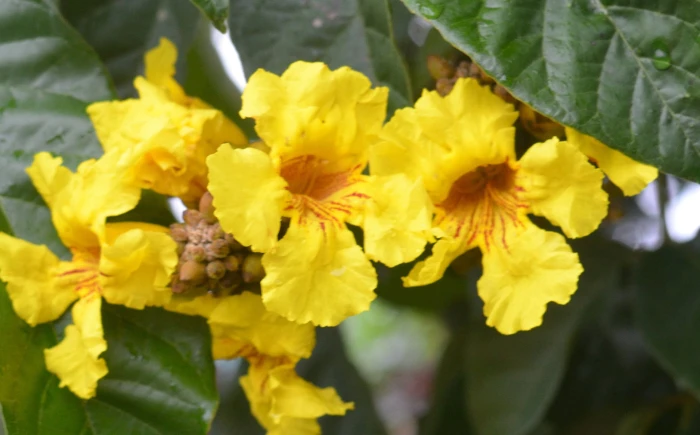

Ajay
CC BY 4.0

Image By:
Ajay
Recorded By:
Copyright:
CC BY 4.0
Copyright Notice:
Photo by: Ajay | License Type: CC BY 4.0 | License URL: http://creativecommons.org/licenses/by/4.0/ | Rights Holder: Ajay | Publisher: iNaturalist | Date Created: 2020-09-22T17:47:33-07:00 |



Summary
Markhamia lutea, commonly known as the Siala Tree, is a deciduous tree in its native range but can behave as a semi-deciduous or evergreen tree in cultivation, depending on the climate. It is native to open woodlands, forest edges, and savannahs in East Africa. In its natural habitat, it can reach heights of over 10 meters, but outside its native zones, it typically grows to 4–5 meters. The Siala Tree has a spreading canopy with pinnate leaves and is known for its showy, trumpet-shaped yellow flowers that bloom in clusters, primarily during the spring, summer, and fall. The bark is smooth and gray, and the tree may produce elongated fruits that split open to release winged seeds.
The Siala Tree is valued for its ornamental flowers and is used in tropical and subtropical landscapes for shade or as a specimen tree. It is relatively easy to maintain and can adapt to a range of soil types, provided they have medium drainage. While it prefers full sun, it can tolerate light shade. It is not commonly found in cultivation outside its native range, but where it is grown, it requires protection from frost. Gardeners should be aware that it can be susceptible to root rot if overwatered and may attract pests such as aphids.CC BY-SA 4.0
The Siala Tree is valued for its ornamental flowers and is used in tropical and subtropical landscapes for shade or as a specimen tree. It is relatively easy to maintain and can adapt to a range of soil types, provided they have medium drainage. While it prefers full sun, it can tolerate light shade. It is not commonly found in cultivation outside its native range, but where it is grown, it requires protection from frost. Gardeners should be aware that it can be susceptible to root rot if overwatered and may attract pests such as aphids.CC BY-SA 4.0
Plant Description
- Plant Type: Tree
- Height: 20-30 feet
- Width: 10-20 feet
- Growth Rate: Moderate
- Flower Color: Yellow
- Flowering Season: Spring, Summer, Fall
- Leaf Retention: Deciduous
Growth Requirements
- Sun: Full Sun
- Drainage: Medium
Common Uses
Bee Garden, Bird Garden, Butterfly Garden, Low Maintenance, Showy Flowers
Natural Habitat
Native to open woodlands, forest edges, and savannahs in Central and East Africa
Other Names
Common Names: Nile Tulip, Nile Trumpet, Siala
Scientific Names: Markhamia lutea, Markhamia hildebrandtii, Markhamia platycalyx, Dolichandrone platycalyx, Dolichandrone lutea, Dolichandrone hildebrandtii, Markhamia hildebrantii, Muenteria lutea, Spathodea lutea
GBIF Accepted Name: Markhamia lutea (Benth.) K.Schum.