Golden Samphire
/
(Limbarda crithmoides)
Golden Samphire (Limbarda crithmoides)
/


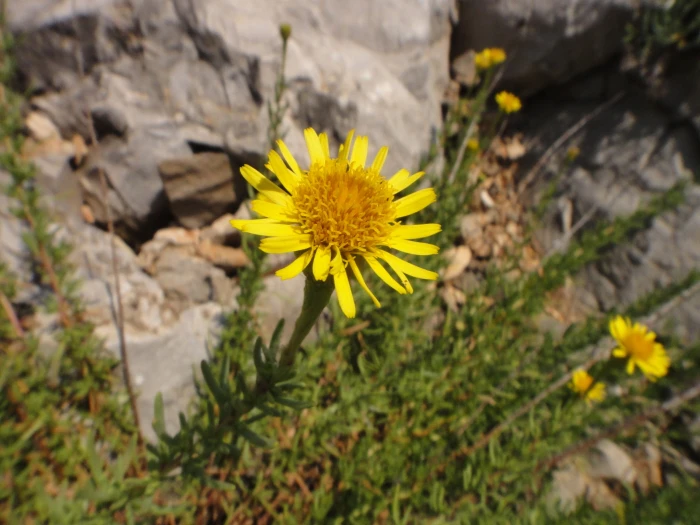

Christian Berg
CC BY 4.0

Image By:
Christian Berg
Recorded By:
Copyright:
CC BY 4.0
Copyright Notice:
Photo by: Christian Berg | License Type: CC BY 4.0 | License URL: http://creativecommons.org/licenses/by/4.0/ | Rights Holder: Christian Berg | Publisher: iNaturalist | Date Created: 2015-07-18T14:02:45-07:00 |





Summary
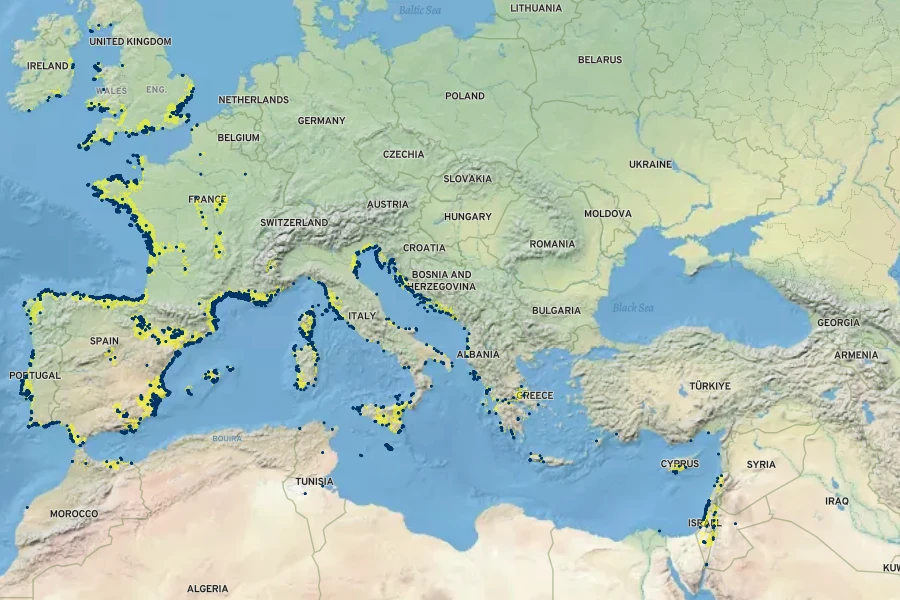
Limbarda crithmoides, commonly known as golden samphire, is a perennial herb native to coastal salt marshes, sea cliffs, and rocky coastal areas of Europe as well as the Mediterranean basin. This species is particularly adapted to saline environments and can often be found in regions including Algeria, Libya, Israel, and Spain. Golden samphire typically grows up to 3 feet tall and features narrow, fleshy, green to yellow-green leaves. From June to October, it produces large, showy yellow flower heads that are capable of self-pollination, but also attract bees, flies, and beetles for cross-pollination.
Golden samphire is valued for its ornamental qualities, especially its vibrant yellow flowers and succulent-like foliage. It is used in coastal gardens for its tolerance to salt spray and can contribute to soil stabilization on sea cliffs and dunes. In cultivation, it requires well-drained soils, full sun, and can tolerate drought once established. The young leaves of golden samphire are edible and have a history of being sold in London markets for pickling. Its potential for saline agriculture has been explored in Lebanon, indicating its use in sustainable agricultural practices in salt-affected areas. Care should be taken to avoid over-harvesting in the wild due to its culinary and ornamental appeal.CC BY-SA 4.0
Golden samphire is valued for its ornamental qualities, especially its vibrant yellow flowers and succulent-like foliage. It is used in coastal gardens for its tolerance to salt spray and can contribute to soil stabilization on sea cliffs and dunes. In cultivation, it requires well-drained soils, full sun, and can tolerate drought once established. The young leaves of golden samphire are edible and have a history of being sold in London markets for pickling. Its potential for saline agriculture has been explored in Lebanon, indicating its use in sustainable agricultural practices in salt-affected areas. Care should be taken to avoid over-harvesting in the wild due to its culinary and ornamental appeal.CC BY-SA 4.0
Plant Description
- Plant Type: Herb
- Height: 1-2 feet
- Width: 1-2 feet
- Growth Rate: Moderate
- Flower Color: Yellow
- Flowering Season: Summer
- Leaf Retention: Evergreen
Growth Requirements
- Sun: Full Sun
- Drainage: Fast, Medium
Common Uses
Drought Tolerant, Edible*Disclaimer: Easyscape's listed plant edibility is for informational use. Always verify the safety and proper identification of any plant before consumption., Low Maintenance, Salt Tolerant
Natural Habitat
Coastal salt marshes, sea cliffs, and rocky coastal areas in Europe and the Mediterranean basin
Other Names
Common Names: Sea Fennel, Rock Samphire
Scientific Names: Limbarda crithmoides, Aster crithmifolius, Eritheis maritima, Helenium crithmoides, Inula acutifolia, Inula crassifolia, Inula crithmifolia, Inula crithmoides, Inula crithmoides subsp. crithmoides, Inula crithmoides subsp. longifolia
GBIF Accepted Name: Limbarda crithmoides