Dotted Blazing Star
/
(Liatris punctata)
Dotted Blazing Star (Liatris punctata)
/


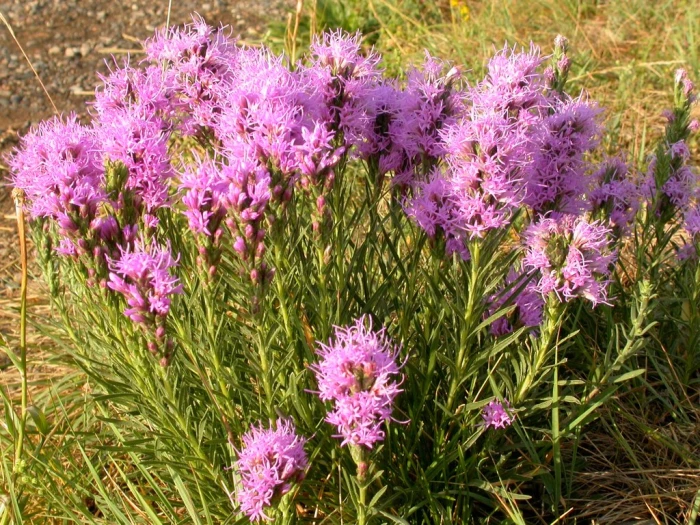

Matt Lavin from Bozeman, Montana, USA
CC BY-SA 2.0

Image By:
Matt Lavin from Bozeman, Montana, USA
Recorded By:
Copyright:
CC BY-SA 2.0
Copyright Notice:
Photo by: Matt Lavin from Bozeman, Montana, USA | License Type: CC BY-SA 2.0 | License URL: https://creativecommons.org/licenses/by-sa/2.0 | Uploader: File Upload Bot (Magnus Manske) | Publisher: Wikimedia Commons | Title: Liatris_punctata.jpg | Notes: {{Information |Description= Ligustrum japonicum |Source=Fotografía del autor (own work) |Date=22-11-06 |Author=José Luis Gálvez |Permission=CC |other_versions=No }} |



Summary
Liatris punctata, commonly known as Dotted Blazing Star, is a deciduous perennial herb native to North American prairies, including the Central USA and extending into Northeastern Mexico. It typically grows 14 to 85 cm (6 in to 2 ft 9 in) tall and features erect stems that support a spike of several flower heads. The flowers are predominantly purple, though white variations can occur, and bloom from late summer to early fall. The fruit is an achene with a tuft of feathery bristles, aiding in wind dispersal. Dotted Blazing Star is a slow-growing, long-lived species, with some individuals living over 35 years. It is adapted to survive periodic wildfires and is drought-resistant due to its deep root system.
Dotted Blazing Star is valued for its showy purple flowers and its ability to thrive in tough conditions, making it a suitable choice for xeriscaping and native plant gardens. It is also used for prairie restoration and as an ornamental plant in borders and naturalized areas. In cultivation, it prefers full sun and can tolerate a range of soil moisture levels and drainage types. While it is drought-tolerant, it will flourish with medium amounts of water. This species is not typically associated with significant disease or pest problems, but it can be less abundant during prolonged droughts.CC BY-SA 4.0
Dotted Blazing Star is valued for its showy purple flowers and its ability to thrive in tough conditions, making it a suitable choice for xeriscaping and native plant gardens. It is also used for prairie restoration and as an ornamental plant in borders and naturalized areas. In cultivation, it prefers full sun and can tolerate a range of soil moisture levels and drainage types. While it is drought-tolerant, it will flourish with medium amounts of water. This species is not typically associated with significant disease or pest problems, but it can be less abundant during prolonged droughts.CC BY-SA 4.0
Plant Description
- Plant Type: Herb
- Height: 1-2 feet
- Width: 0.7-1 feet
- Growth Rate: Slow
- Flower Color: Purple
- Flowering Season: Summer
- Leaf Retention: Deciduous
Growth Requirements
- Sun: Full Sun
- Drainage: Fast, Medium, Slow
Common Uses
Bee Garden, Bird Garden, Butterfly Garden, Deer Resistant, Drought Tolerant, Fire Resistant, Groundcover, Hummingbird Garden, Low Maintenance, Showy Flowers, Street Planting
Natural Habitat
Prairies in the Central USA and Northeastern Mexico
Other Names
Common Names: Narrow-Leaved Blazing-Star, Dotted Gayfeather, Snakeroot, Herbst-Prachtscharte, Liatris Ponctué
Scientific Names: Dotted Gayfeather
GBIF Accepted Name: Liatris punctata Hook.