Japanese Walnut
/
(Juglans ailantifolia)
Japanese Walnut (Juglans ailantifolia)
/


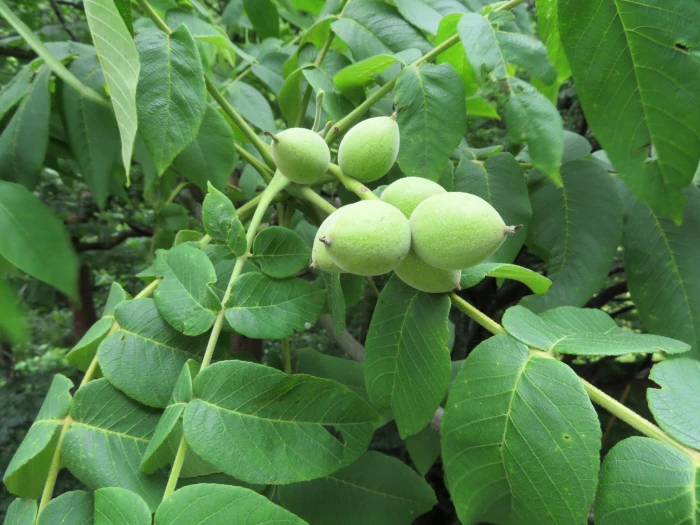

belvedere04
CC BY 4.0

Image By:
belvedere04
Recorded By:
Copyright:
CC BY 4.0
Copyright Notice:
Photo by: belvedere04 | License Type: CC BY 4.0 | License URL: http://creativecommons.org/licenses/by/4.0/ | Rights Holder: belvedere04 | Publisher: iNaturalist | Date Created: 2023-06-16T10:17:15-07:00 |






Summary
Juglans ailantifolia, commonly known as Japanese walnut, is a deciduous tree native to mountain forests and riverbanks in Japan and Sakhalin. It can grow up to 66 feet tall and is characterized by its light grey bark and pinnate leaves that turn yellow in the fall. The tree produces spherical nuts that are encased in green husks, maturing in mid-autumn. These nuts are edible and prized for their oily texture and rich flavor.
Japanese walnut is valued for its nuts and is often planted in orchards or home gardens for this purpose. It is also used as a shade tree due to its broad canopy. In cultivation, it prefers full sun to part shade and requires well-drained soil. It is relatively low-maintenance but can be susceptible to walnut blight and root rot. Due to its potential to spread, it is important to check local regulations before planting Juglans ailantifolia outside its native range.CC BY-SA 4.0
Japanese walnut is valued for its nuts and is often planted in orchards or home gardens for this purpose. It is also used as a shade tree due to its broad canopy. In cultivation, it prefers full sun to part shade and requires well-drained soil. It is relatively low-maintenance but can be susceptible to walnut blight and root rot. Due to its potential to spread, it is important to check local regulations before planting Juglans ailantifolia outside its native range.CC BY-SA 4.0
Plant Description
- Plant Type: Tree
- Height: 70-90 feet
- Width: 40-60 feet
- Growth Rate: Rapid
- Flower Color: Green
- Flowering Season: Spring
- Leaf Retention: Deciduous
Growth Requirements
- Sun: Full Sun
- Drainage: Medium, Fast
Common Uses
Bird Garden
Natural Habitat
Mountain forests and riverbanks
Other Names
Common Names: Giant Walnut
Scientific Names: Juglans ailantifolia, Juglans allardiana, Juglans allardiana var. acuta, Juglans coarctata, Juglans cordiformis var. ailantifolia, Juglans coreensis, Juglans japonica, Juglans japonica, Juglans japonica
GBIF Accepted Name: Juglans ailantifolia