Bodeka
/
(Glinus oppositifolius)
Bodeka (Glinus oppositifolius)
/


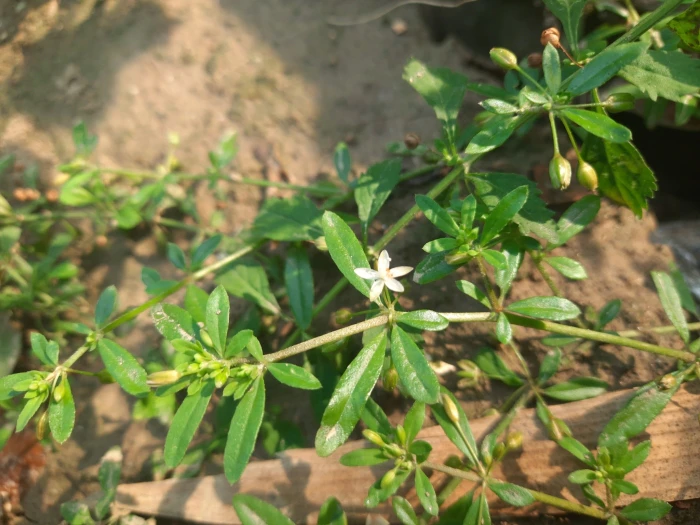

© মহা বিদ্রোহী BUT রণ ক্লান্ত
CC BY 4.0

Image By:
© মহা বিদ্রোহী BUT রণ ক্লান্ত
Recorded By:
Copyright:
CC BY 4.0
Copyright Notice:
Photo by: © মহা বিদ্রোহী BUT রণ ক্লান্ত | License Type: CC BY 4.0 | License URL: http://creativecommons.org/licenses/by/4.0/ | Uploader: le_verrier | Publisher: iNaturalist |





Summary
Glinus oppositifolius, commonly known as Bodeka, Sweet Glinus, Makulu-Kulu, Nienie, or Slender Carpetweed, is an annual herb native to a variety of habitats including grasslands, riverbanks, and disturbed areas in Africa, Asia, and Australia. It typically grows to a height and width of 0.5-2 feet (0.15-0.6 meters), forming a sprawling mat. The plant features succulent stems and opposite leaves, with white or yellow flowers that are small but can be quite numerous, blooming profusely in the summer and fall. The flowers open in the morning and close by afternoon.
Sweet Glinus is valued for its rapid growth and adaptability to various soil types. It is used as a ground cover in some regions and has traditional medicinal uses, including as a treatment for inflammation and gastrointestinal disorders. In cultivation, it requires full sun to part shade, thriving in medium-draining clay or loam soils. While it can be a useful plant, Glinus oppositifolius is known to spread aggressively outside its native range, and gardeners should be cautious about introducing it to new areas. It can outcompete native vegetation and is particularly problematic in wetland and riparian zones.CC BY-SA 4.0
Sweet Glinus is valued for its rapid growth and adaptability to various soil types. It is used as a ground cover in some regions and has traditional medicinal uses, including as a treatment for inflammation and gastrointestinal disorders. In cultivation, it requires full sun to part shade, thriving in medium-draining clay or loam soils. While it can be a useful plant, Glinus oppositifolius is known to spread aggressively outside its native range, and gardeners should be cautious about introducing it to new areas. It can outcompete native vegetation and is particularly problematic in wetland and riparian zones.CC BY-SA 4.0
Plant Description
- Plant Type: Herb
- Height: 0.5-2 feet
- Width: 0.5-2 feet
- Growth Rate: Rapid
- Flower Color: White, Yellow
- Flowering Season: Summer, Fall
- Leaf Retention: Deciduous
Growth Requirements
- Sun: Full Sun, Part Shade
- Drainage: Medium
Common Uses
Low Maintenance
Natural Habitat
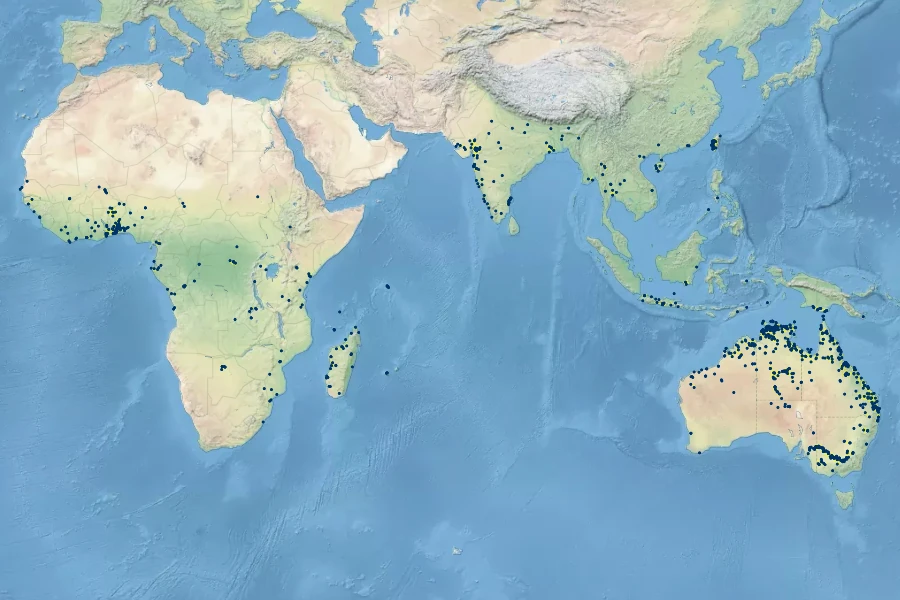
Native to grasslands, riverbanks, and disturbed areas in Africa, Asia, and Australia
Other Names
Common Names: Sweet Glinus, Makulu-Kulu, Nienie, Slender Carpetweed, Tokwakuna, Oppositeleaf Carpetweed
Scientific Names: Glinus oppositifolius, Glinus denticulatus, Glinus mollugo, Glinus mollugo var. natalensis, Glinus oppositifolius var. parviflorus, Glinus spergula, Glinus spergula, Mollugo denticulata, Mollugo erecta
GBIF Accepted Name: Glinus oppositifolius