Petty Spurge
/
(Euphorbia peplus)
Petty Spurge (Euphorbia peplus)
/


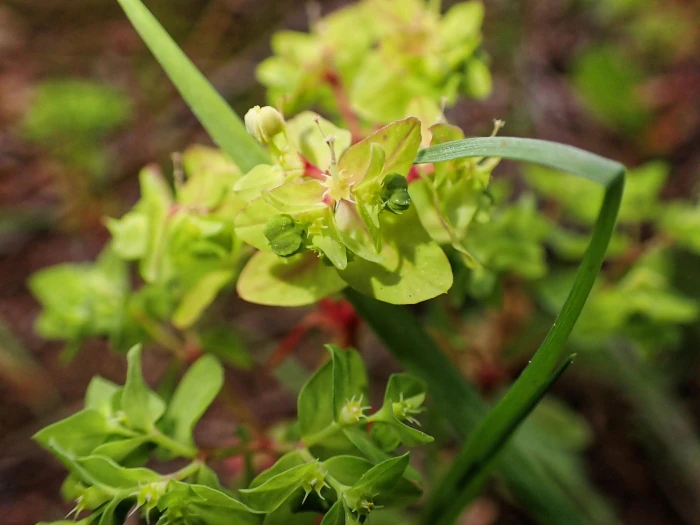

Donald Davesne
CC BY 4.0

Image By:
Donald Davesne
Recorded By:
Copyright:
CC BY 4.0
Copyright Notice:
Photo by: Donald Davesne | License Type: CC BY 4.0 | License URL: http://creativecommons.org/licenses/by/4.0/ | Rights Holder: Donald Davesne | Publisher: iNaturalist | Date Created: 2023-03-24T16:15:50-07:00 |






Summary
Euphorbia peplus, commonly known as petty spurge or cancer weed, is an annual herb native to a variety of habitats including open woodlands, grasslands, and disturbed sites across Europe, northern Africa, and western Asia. It often colonizes cultivated arable land, gardens, and waste spaces. The plant typically grows 2-12 inches tall with smooth, hairless stems and oval-acute leaves arranged in a spiral. It produces inconspicuous green flowers in three-rayed umbels with distinctive kidney-shaped glands from spring to early fall. While the flowers are not showy, they are interesting upon close inspection.
Petty spurge is known for its sap, which contains ingenol mebutate, a substance toxic to rapidly replicating human tissue and traditionally used to treat skin lesions, including certain types of skin cancer. It is easy to grow and maintain, thriving in a range of soil types, from sandy to loamy, and preferring full sun to part shade. However, gardeners should handle it with care due to its toxic sap and potential to self-seed prolifically. It is important to wear gloves when handling the plant to avoid skin irritation. Petty spurge is valued for its traditional medicinal uses but is invasive in Australia, New Zealand, and North America, spreading widely in temperate and subtropical regions.CC BY-SA 4.0
Petty spurge is known for its sap, which contains ingenol mebutate, a substance toxic to rapidly replicating human tissue and traditionally used to treat skin lesions, including certain types of skin cancer. It is easy to grow and maintain, thriving in a range of soil types, from sandy to loamy, and preferring full sun to part shade. However, gardeners should handle it with care due to its toxic sap and potential to self-seed prolifically. It is important to wear gloves when handling the plant to avoid skin irritation. Petty spurge is valued for its traditional medicinal uses but is invasive in Australia, New Zealand, and North America, spreading widely in temperate and subtropical regions.CC BY-SA 4.0
Plant Description
- Plant Type: Herb
- Height: 0.5-1.5 feet
- Width: 0.5-0.5 feet
- Growth Rate: Rapid
- Flower Color: Green, Yellow
- Flowering Season: Spring, Summer, Fall
- Leaf Retention:
Growth Requirements
- Sun: Full Sun, Part Shade
- Drainage: Fast, Medium, Slow
Common Uses
Erosion Control, Low Maintenance
Natural Habitat
Open woodlands, grasslands, and disturbed sites across Europe, northern Africa, and western Asia
Other Names
Common Names: Milk Weed, Radium-Plant, Cancer Weed
Scientific Names: Euphorbia peplus, Esula peplus, Euphorbia peplus var. amponitana, Euphorbion peplum, Galarhoeus peplus, Galarhoeus peplus, Galarhoeus peplus, Galarhoeus peplus, Keraselma peplus, Keraselma peplus
GBIF Accepted Name: Euphorbia peplus