Sicily Spurge
/
(Euphorbia ceratocarpa)
Sicily Spurge (Euphorbia ceratocarpa)
/


je_wyer
CC BY 2.0

Image By:
je_wyer
Recorded By:
Copyright:
CC BY 2.0
Copyright Notice:
Photo by: je_wyer | License Type: CC BY 2.0 | License URL: https://creativecommons.org/publicdomain/zero/1.0/ | Uploader: je_wyer | Publisher: Flickr |





Summary
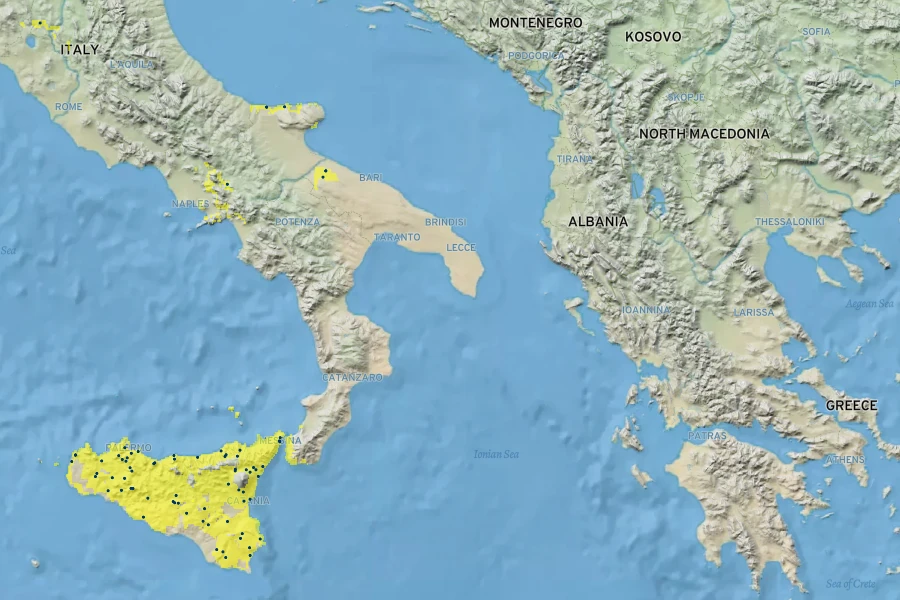
Euphorbia ceratocarpa, commonly known as Horned Spurge, is an evergreen perennial herb native to the Mediterranean region, specifically Sicily and southern Italy. It thrives in rocky outcrops and coastal areas where it is adapted to dry, well-drained soils. This species reaches a height and width of approximately 1.7 m (5.6 ft), featuring long, narrow leaves with a distinctive white midrib. During the summer, it produces clusters of green and yellow flowers that are quite showy and can have an extended flowering period in favorable conditions.
Horned Spurge is appreciated for its drought tolerance and striking floral display, making it a suitable choice for xeriscaping and Mediterranean gardens. It has been awarded the Royal Horticultural Society’s Award of Garden Merit, indicating its value in cultivation. The plant’s milky sap is a notable characteristic; it is toxic if ingested and can cause skin and eye irritation upon contact. Therefore, gardeners should handle this plant with care and consider wearing gloves. In cultivation, Horned Spurge performs best in full sun to part shade and requires well-drained soil. It is hardy down to −10 °C (14 °F), but optimal growth is observed in warm, sheltered locations. While it is generally low-maintenance, overwatering should be avoided to prevent root rot.CC BY-SA 4.0
Horned Spurge is appreciated for its drought tolerance and striking floral display, making it a suitable choice for xeriscaping and Mediterranean gardens. It has been awarded the Royal Horticultural Society’s Award of Garden Merit, indicating its value in cultivation. The plant’s milky sap is a notable characteristic; it is toxic if ingested and can cause skin and eye irritation upon contact. Therefore, gardeners should handle this plant with care and consider wearing gloves. In cultivation, Horned Spurge performs best in full sun to part shade and requires well-drained soil. It is hardy down to −10 °C (14 °F), but optimal growth is observed in warm, sheltered locations. While it is generally low-maintenance, overwatering should be avoided to prevent root rot.CC BY-SA 4.0
Plant Description
- Plant Type: Herb
- Height: 3-6 feet
- Width: 3-6 feet
- Growth Rate: Moderate
- Flower Color: Yellow, Green
- Flowering Season: Spring, Summer
- Leaf Retention: Evergreen
Growth Requirements
- Sun: Full Sun, Part Shade
- Drainage: Medium
Common Uses
Bee Garden, Bird Garden, Butterfly Garden, Deer Resistant, Drought Tolerant, Low Maintenance, Rabbit Resistant, Showy Flowers
Natural Habitat
Mediterranean rocky outcrops and coastal areas
Other Names
Common Names:
Scientific Names: Euphorbia ceratocarpa, Euphorbia muscosa, Tithymalus ceratocarpus
GBIF Accepted Name: Euphorbia ceratocarpa Ten.