Honey Suckle
/
(Eryngium floribundum)
Honey Suckle (Eryngium floribundum)
/





Image By:
Recorded By:
Copyright:
Copyright Notice:




Summary
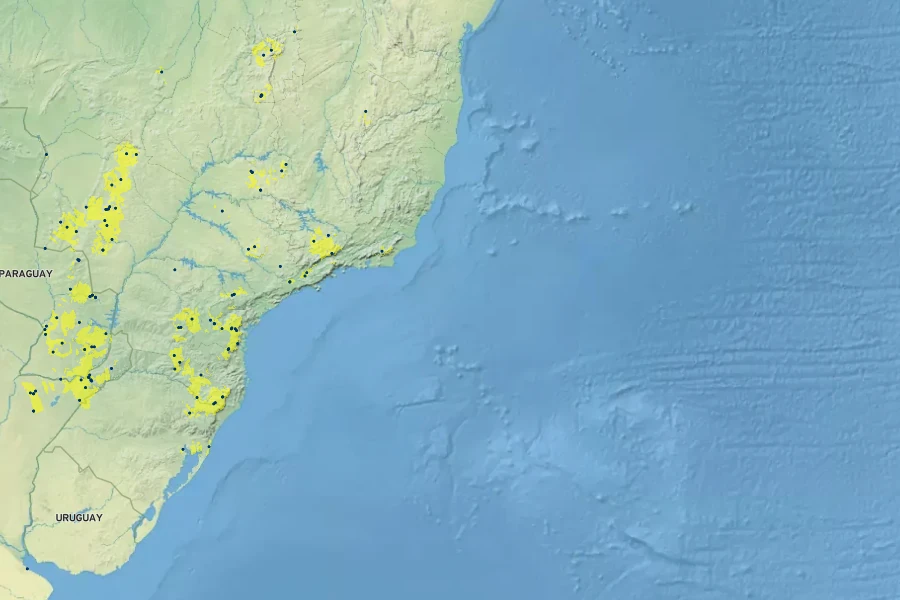
Eryngium floribundum, commonly known as Honey Suckle or Panicled Eryngo, is a perennial herb native to the moist savannas and grasslands of South America, particularly in Brazil and Argentina. It typically grows at a moderate rate to a height of 2-4 feet (0.6-1.2 meters) and a width of 1.5-2.5 feet (0.5-0.8 meters). This plant is characterized by its spiny-toothed leaves and branching stems topped with clusters of small, globular, and intensely blue flowers that bloom in the summer, providing a showy display that attracts pollinators such as bees and butterflies.
Panicled Eryngo is valued for its striking blue flowers and architectural form, making it a unique addition to borders, rock gardens, and xeriscaping. It is also used in fresh and dried floral arrangements. In cultivation, it requires full sun exposure and thrives in medium or fast-draining clay, loam, or sandy soils. Gardeners should be aware that Eryngium species can have sharp edges, so they should be placed where they will not be brushed against frequently. Despite its common name, it is not related to true honeysuckle (Lonicera spp.) and does not have a fragrance.CC BY-SA 4.0
Panicled Eryngo is valued for its striking blue flowers and architectural form, making it a unique addition to borders, rock gardens, and xeriscaping. It is also used in fresh and dried floral arrangements. In cultivation, it requires full sun exposure and thrives in medium or fast-draining clay, loam, or sandy soils. Gardeners should be aware that Eryngium species can have sharp edges, so they should be placed where they will not be brushed against frequently. Despite its common name, it is not related to true honeysuckle (Lonicera spp.) and does not have a fragrance.CC BY-SA 4.0
Plant Description
- Plant Type: Herb
- Height: 2-4 feet
- Width: 1.5-2.5 feet
- Growth Rate: Moderate
- Flower Color: Blue
- Flowering Season: Summer
- Leaf Retention: Evergreen
Growth Requirements
- Sun: Full Sun
- Drainage: Medium, Fast
Common Uses
Bee Garden, Border Plant, Butterfly Garden, Low Maintenance, Showy Flowers, Water Garden
Natural Habitat
Moist savannas and grasslands of South America, particularly in Brazil and Argentina
Other Names
Common Names: Panicled Eryngo
Scientific Names: Eryngium floribundum, Eryngium aquaticum, Eryngium floribundum var. angustifolium, Eryngium floribundum var. pycnocephalum, Eryngium floribundum var. serroides
GBIF Accepted Name: Eryngium floribundum