Ten-Angled Pipewort
/
(Eriocaulon decangulare)
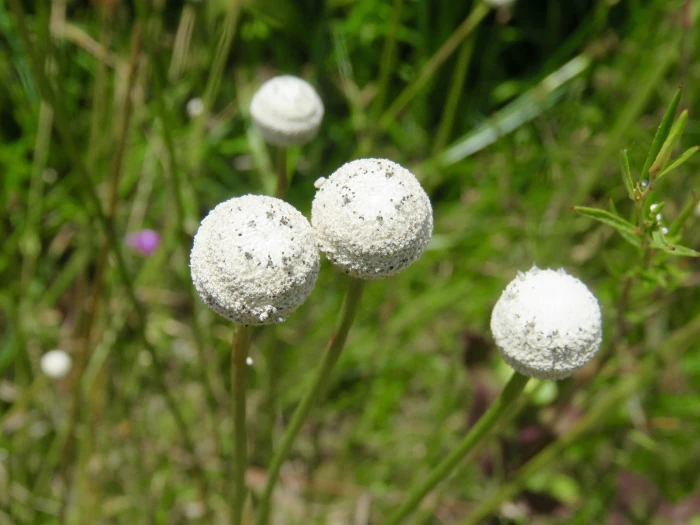
Ten-Angled Pipewort (Eriocaulon decangulare)
/



Laura Clark
CC BY 4.0

Image By:
Laura Clark
Recorded By:
Copyright:
CC BY 4.0
Copyright Notice:
Photo by: Laura Clark | License Type: CC BY 4.0 | License URL: http://creativecommons.org/licenses/by/4.0/ | Rights Holder: Laura Clark | Publisher: iNaturalist | Date Created: 2017-07-08T14:07:01-07:00 |



Summary
Eriocaulon decangulare, commonly known as Ten-angled Pipewort or Hat Pin, is a perennial herb that is native to wetlands in the southeastern United States, extending to Mexico and Nicaragua. It is typically found at low elevations, often below 984 feet, where it thrives in acidic, nutrient-poor conditions such as savannas, bogs, pinelands, and cypress domes. In the U.S., its habitat includes the Atlantic Coastal Plain, with isolated populations in inland and mountainous areas. Ten-angled Pipewort is characterized by its grass-like clumps of narrow, linear leaves and distinctive round, white flower heads that resemble pins, which bloom from late summer to fall.
This plant is valued for its unique appearance and is often used in water gardens and naturalized wetland plantings. It requires full sun to partial shade and consistently moist to wet soils, making it suitable for bog gardens and the edges of ponds. Ten-angled Pipewort is relatively low maintenance but may require division if it becomes too dense. It is not commonly affected by diseases or pests, although it can be sensitive to water quality and may struggle in polluted conditions.CC BY-SA 4.0
This plant is valued for its unique appearance and is often used in water gardens and naturalized wetland plantings. It requires full sun to partial shade and consistently moist to wet soils, making it suitable for bog gardens and the edges of ponds. Ten-angled Pipewort is relatively low maintenance but may require division if it becomes too dense. It is not commonly affected by diseases or pests, although it can be sensitive to water quality and may struggle in polluted conditions.CC BY-SA 4.0
Plant Description
- Plant Type: Herb
- Height: 0.5-1.5 feet
- Width: 0.5-1 feet
- Growth Rate: Moderate
- Flower Color: White
- Flowering Season: Spring, Summer
- Leaf Retention: Deciduous
Growth Requirements
- Sun: Full Sun, Part Shade
- Drainage: Slow
Common Uses
Low Maintenance, Water Garden
Natural Habitat
Native to wetlands in the southeastern United States, including savannas, bogs, pinelands, and cypress domes
Other Names
Common Names: Hatpins
Scientific Names: Eriocaulon decangulare, Eriocaulon decangulare var. latifolium, Eriocaulon decemangulare, Eriocaulon gnaphalioides, Randalia decangularis, Symphachne xyrioides, Symphachne xyrioides
GBIF Accepted Name: Eriocaulon decangulare