Common Pipewort
/
(Eriocaulon aquaticum)
Common Pipewort (Eriocaulon aquaticum)
/


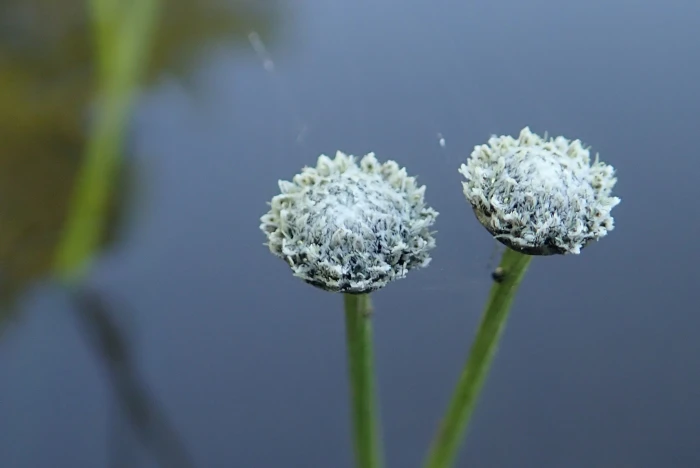

Laura J. Costello
CC BY 4.0

Image By:
Laura J. Costello
Recorded By:
Copyright:
CC BY 4.0
Copyright Notice:
Photo by: Laura J. Costello | License Type: CC BY 4.0 | License URL: http://creativecommons.org/licenses/by/4.0/ | Rights Holder: Laura J. Costello | Publisher: iNaturalist | Date Created: 2018-07-05T06:29:48-07:00 |






Summary
Eriocaulon aquaticum, commonly known as Common Pipewort, Northern Pipewort, Seven-angled Pipewort, and Hatpins, is a perennial herb that thrives in wetland habitats such as bogs, fens, shallow ponds, and the margins of slow-moving streams and rivers. It is native to North America and parts of Europe, including the United Kingdom and Ireland. In North America, its range extends from Alabama to Wisconsin and up into Canadian regions such as Labrador and Québec. This aquatic plant typically reaches up to 8 inches in height when growing emersed but can grow several feet tall when fully submerged.
Eriocaulon aquaticum is notable for its grass-like basal leaves and spherical inflorescences composed of numerous tiny white flowers held aloft on long, unbranched stems. These flowers bloom from late summer to early fall and are quite showy, attracting attention in water garden settings. The plant is valued for its unique appearance and is often used in water gardens, aquariums, and naturalized pond settings. It prefers full sun to part shade, acidic to neutral pH water, and can tolerate a range of water depths. While it does not have significant disease problems, it can be sensitive to water pollution and requires clean, nutrient-poor conditions to thrive. Eriocaulon aquaticum should be monitored to ensure it does not spread beyond its intended area in cultivation.CC BY-SA 4.0
Eriocaulon aquaticum is notable for its grass-like basal leaves and spherical inflorescences composed of numerous tiny white flowers held aloft on long, unbranched stems. These flowers bloom from late summer to early fall and are quite showy, attracting attention in water garden settings. The plant is valued for its unique appearance and is often used in water gardens, aquariums, and naturalized pond settings. It prefers full sun to part shade, acidic to neutral pH water, and can tolerate a range of water depths. While it does not have significant disease problems, it can be sensitive to water pollution and requires clean, nutrient-poor conditions to thrive. Eriocaulon aquaticum should be monitored to ensure it does not spread beyond its intended area in cultivation.CC BY-SA 4.0
Plant Description
- Plant Type: Herb
- Height: 0.5-2 feet
- Width: 0.5-1 feet
- Growth Rate: Slow
- Flower Color: White
- Flowering Season: Spring, Summer, Fall
- Leaf Retention: Semi-deciduous
Growth Requirements
- Sun: Full Sun
- Drainage: Standing
Common Uses
Low Maintenance, Water Garden
Natural Habitat
Native to wetland habitats such as bogs, fens, shallow ponds, and the margins of slow-moving streams and rivers in North America and parts of Europe, including the United Kingdom and Ireland
Other Names
Common Names: Hatpins, Sevenangle Pipewort, Common Pipewort, Seven-Angled Pipewort, Aquatic Pipewort, White Buttons
Scientific Names: Eriocaulon aquaticum, Cespa aquatica, Eriocaulon articulatum, Eriocaulon brevifolium, Eriocaulon pellucidum, Eriocaulon pellucidum f. clausenii, Eriocaulon pellucidum f. pumilum, Eriocaulon pumilum, Eriocaulon septangulare
GBIF Accepted Name: Eriocaulon aquaticum