Guernsey Fleabane
/
(Erigeron sumatrensis)
Guernsey Fleabane (Erigeron sumatrensis)
/


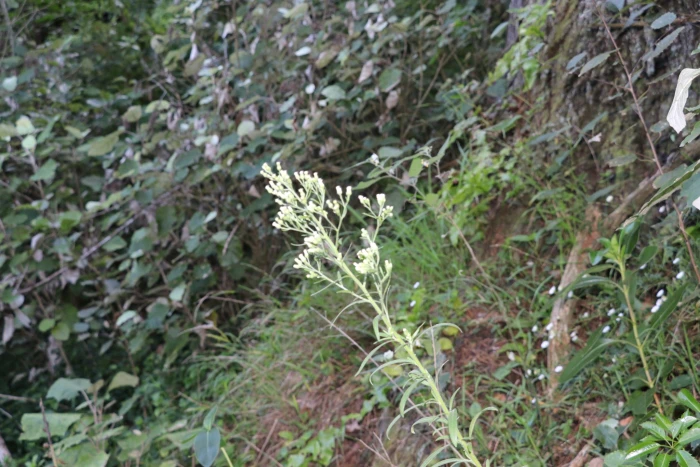

Andy McKay
CC BY 4.0

Image By:
Andy McKay
Recorded By:
Copyright:
CC BY 4.0
Copyright Notice:
Photo by: Andy McKay | License Type: CC BY 4.0 | License URL: http://creativecommons.org/licenses/by/4.0/ | Rights Holder: Andy McKay | Publisher: iNaturalist | Date Created: 2018-04-05T12:41:43-07:00 |



Summary
Erigeron sumatrensis, commonly known as Guernsey fleabane or Sumatran fleabane, is an annual herb that is likely native to Central and South America. It has become widely naturalized in various habitats such as disturbed sites, roadsides, and urban areas in tropical and subtropical regions, including the British Isles, North America, Europe, Africa, Asia, and Australasia. Typically, it grows to a height of 3 to 6 feet with a bushy form. The plant produces abundant white, daisy-like flowers with yellow centers throughout the summer, which are followed by dandelion-like seed heads that facilitate its spread.
Guernsey fleabane is known for its rapid growth and ability to colonize disturbed areas quickly, which can be beneficial for erosion control or as a pioneer species in restoration projects. However, its invasive nature makes it unsuitable for many gardens. It thrives in a range of soil types, from poor to fertile, and prefers full sun to partial shade. It requires minimal water once established, making it a low-maintenance option for xeriscaping. In cultivation, it is not commonly used due to its invasive potential and is often removed to prevent spreading. Guernsey fleabane is invasive across tropical and subtropical regions worldwide, spreading as a fast-growing weed.CC BY-SA 4.0
Guernsey fleabane is known for its rapid growth and ability to colonize disturbed areas quickly, which can be beneficial for erosion control or as a pioneer species in restoration projects. However, its invasive nature makes it unsuitable for many gardens. It thrives in a range of soil types, from poor to fertile, and prefers full sun to partial shade. It requires minimal water once established, making it a low-maintenance option for xeriscaping. In cultivation, it is not commonly used due to its invasive potential and is often removed to prevent spreading. Guernsey fleabane is invasive across tropical and subtropical regions worldwide, spreading as a fast-growing weed.CC BY-SA 4.0
Plant Description
- Plant Type: Herb
- Height: 1.5-3 feet
- Width: 1-1.5 feet
- Growth Rate: Rapid
- Flower Color: Pink, White
- Flowering Season: Spring, Summer, Fall
- Leaf Retention: Evergreen, Semi-deciduous
Growth Requirements
- Sun: Full Sun
- Drainage: Fast, Medium, Slow
Common Uses
Border Plant, Low Maintenance
Natural Habitat
Likely native to Central and South America and naturalized in disturbed sites, roadsides, and urban areas
Other Names
Common Names: Sumatran Fleabane, Guernsey Fleabane, Broadleaf Fleabane, Tall Fleabane, Daisy Fleabane
Scientific Names: Erigeron sumatrensis, Aster ambiguus, Baccharis ivifolia, Conyza altissima, Conyza altissima, Conyza ambigua, Conyza bonariensis f. subleiotheca, Conyza bonariensis var. microcephala, Conyza erigeroides, Conyza floribunda var. laciniata
GBIF Accepted Name: Erigeron sumatrensis