Perennial Veldtgrass
/
(Ehrharta calycina)
Perennial Veldtgrass (Ehrharta calycina)
/


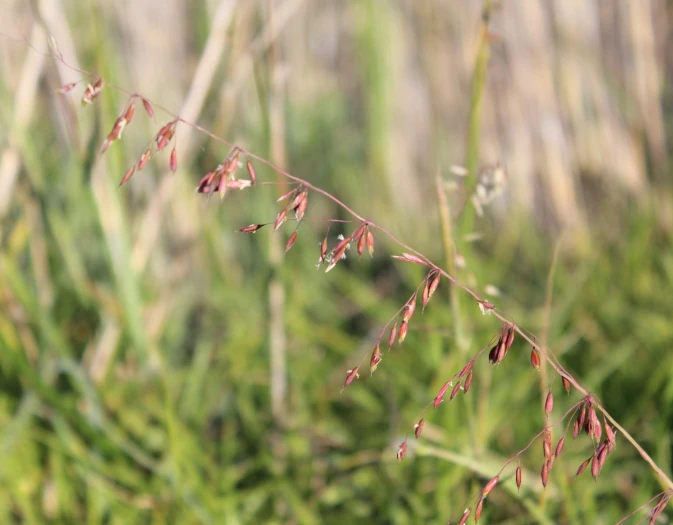

© Noeleen du Toit
CC BY-SA 4.0

Image By:
© Noeleen du Toit
Recorded By:
Copyright:
CC BY-SA 4.0
Copyright Notice:
Photo by: © Noeleen du Toit | License Type: CC BY-SA 4.0 | License URL: http://creativecommons.org/licenses/by-sa/4.0/ | Uploader: anibotani | Publisher: iNaturalist |



Summary
Ehrharta calycina, commonly known as perennial veldtgrass or purple veldtgrass, is a perennial grass native to a variety of habitats in southern Africa, including grasslands, open woodlands, and rocky slopes in South Africa, Lesotho, and Namibia. It typically reaches 12-28 inches in height but can grow taller under optimal conditions. The grass has a tufted habit with narrow, linear leaves and produces airy panicles of purple-tinged flowers that are most prominent in spring and summer.
Perennial veldtgrass is valued for its drought tolerance and is often used for erosion control and as a forage grass in its native range. However, due to its aggressive growth and ability to spread via rhizomes, it is considered invasive in some regions outside its native habitat. In cultivation, it requires minimal water once established and thrives in full sun to part shade, adapting to a range of soil types with good drainage. It is not commonly grown in ornamental gardens due to its invasive nature but may be used in restoration projects where its hardiness is beneficial. Perennial veldtgrass is invasive in California, Australia, and Europe, dominating chaparral and coastal habitats; listed by the EU as an invasive alien species.CC BY-SA 4.0
Perennial veldtgrass is valued for its drought tolerance and is often used for erosion control and as a forage grass in its native range. However, due to its aggressive growth and ability to spread via rhizomes, it is considered invasive in some regions outside its native habitat. In cultivation, it requires minimal water once established and thrives in full sun to part shade, adapting to a range of soil types with good drainage. It is not commonly grown in ornamental gardens due to its invasive nature but may be used in restoration projects where its hardiness is beneficial. Perennial veldtgrass is invasive in California, Australia, and Europe, dominating chaparral and coastal habitats; listed by the EU as an invasive alien species.CC BY-SA 4.0
Plant Description
- Plant Type: Grass
- Height: 1-3 feet
- Width: 2-3 feet
- Growth Rate: Rapid
- Flower Color: N/A
- Flowering Season: Spring, Winter
- Leaf Retention: Evergreen
Growth Requirements
- Sun: Full Sun, Part Shade
- Drainage: Medium, Slow
Common Uses
Erosion Control, Low Maintenance
Natural Habitat
Native to grasslands, open woodlands, and rocky slopes in southern Africa
Other Names
Common Names: Perrenial Veldt Grass, Long-awned Veldt Grass, Veldt Grass
Scientific Names: Ehrharta calycina, Aira capensis, Ehrharta adscendens, Ehrharta auriculata, Ehrharta calycina var. adscendens, Ehrharta calycina var. angustifolia, Ehrharta calycina var. calycina, Ehrharta calycina var. versicolor, Ehrharta geniculata, Ehrharta laxiflora
GBIF Accepted Name: Ehrharta calycina