Wall Whitlowgrass
/
(Drabella muralis)
Wall Whitlowgrass (Drabella muralis)
/


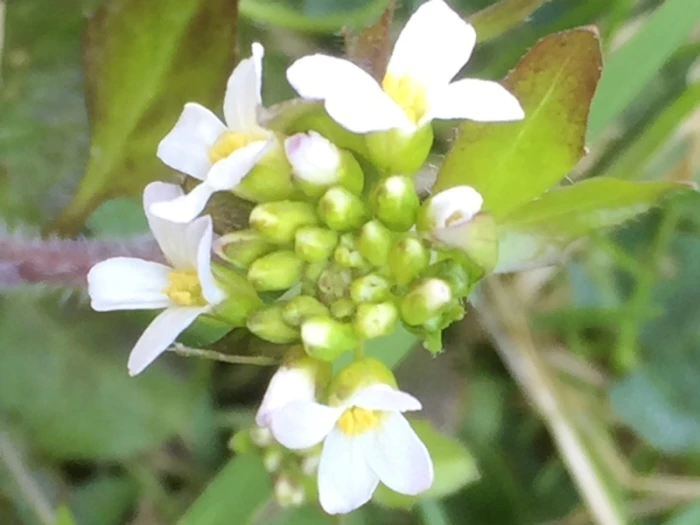

© Andre Hosper
CC BY 4.0

Image By:
© Andre Hosper
Recorded By:
Copyright:
CC BY 4.0
Copyright Notice:
Photo by: © Andre Hosper | License Type: CC BY 4.0 | License URL: http://creativecommons.org/licenses/by/4.0/ | Uploader: ahospers | Publisher: iNaturalist |



Summary
Drabella muralis, commonly known as Wall Whitlowgrass or Wall Draba, is an annual herb that is native to a variety of habitats including rocky slopes, stone walls, and disturbed sites across Europe, Asia, and North Africa. It exhibits a moderate growth rate, typically reaching a height of 0.2-0.5 feet (0.06-0.15 meters) and spreading 0.5-1 feet (0.15-0.3 meters). Wall Whitlowgrass forms a low-growing rosette of leaves from which emerge slender stems topped with clusters of small, four-petaled yellow flowers that bloom in the spring. The plant’s flowers are modest in size but can add a splash of color to rock gardens and alpine collections.
Wall Whitlowgrass is valued for its ability to thrive in challenging conditions, such as crevices in walls or rocky ground, making it a suitable choice for rock gardens, alpine gardens, and as a ground cover in sunny to partially shaded areas. It is undemanding regarding soil type, but it prefers medium to fast-draining loam or sandy soils. While it does best in full sun or part shade, it is also drought-tolerant once established. Wall Whitlowgrass can self-seed prolifically, which can be both a benefit for naturalizing areas and a potential problem if it spreads beyond desired limits.CC BY-SA 4.0
Wall Whitlowgrass is valued for its ability to thrive in challenging conditions, such as crevices in walls or rocky ground, making it a suitable choice for rock gardens, alpine gardens, and as a ground cover in sunny to partially shaded areas. It is undemanding regarding soil type, but it prefers medium to fast-draining loam or sandy soils. While it does best in full sun or part shade, it is also drought-tolerant once established. Wall Whitlowgrass can self-seed prolifically, which can be both a benefit for naturalizing areas and a potential problem if it spreads beyond desired limits.CC BY-SA 4.0
Plant Description
- Plant Type: Herb
- Height: 0.2-0.5 feet
- Width: 0.5-1 feet
- Growth Rate: Moderate
- Flower Color: Yellow
- Flowering Season: Spring
- Leaf Retention:
Growth Requirements
- Sun: Full Sun, Part Shade
- Drainage: Medium, Fast
Common Uses
Border Plant, Low Maintenance, Rock Garden
Natural Habitat
Rocky slopes, stone walls, and disturbed sites across Europe, Asia, and North Africa
Other Names
Common Names: Wall Draba
Scientific Names: Drabella muralis, Crucifera capselloides, Draba muralis, Draba muralis, Draba muralis f. major, Draba muralis f. minor, Draba nemorosa, Draba ramosa, Drabella columnae
GBIF Accepted Name: Drabella muralis