Marvel Grass
/
(Dichanthium annulatum)
Marvel Grass (Dichanthium annulatum)
/


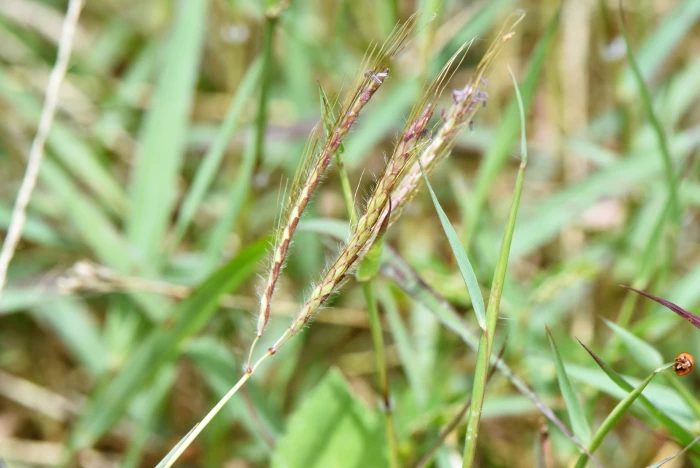

Cheng-Tao Lin
CC BY 4.0

Image By:
Cheng-Tao Lin
Recorded By:
Copyright:
CC BY 4.0
Copyright Notice:
Photo by: Cheng-Tao Lin | License Type: CC BY 4.0 | License URL: http://creativecommons.org/licenses/by/4.0/ | Rights Holder: Cheng-Tao Lin | Publisher: iNaturalist | Date Created: 2020-04-27T11:25:16-07:00 |



Summary
Dichanthium annulatum, commonly known as marvel grass, Diaz bluestem, or Kleberg bluestem, is a perennial grass native to the savannas and open woodlands of tropical Asia, the Middle East, and parts of Africa. It typically grows up to 3 feet in height with erect, tufted stems and rough-haired leaf blades that can reach up to 12 inches in length. The inflorescence consists of racemes bearing pairs of spikelets, one sessile and fertile, the other pedicellate and sterile or male. Flowering occurs in late summer to fall, with the grass producing a brownish-purple tinge that adds visual interest to the landscape.
Marvel grass is valued for its adaptability to a wide range of soil conditions, including clay, sand, and somewhat alkaline and saline soils. Its dense growth habit forms a turf that withstands grazing pressure, making it useful for erosion control and as forage in pastures. In cultivation, it requires minimal maintenance, thriving in full sun and tolerating drought once established. However, it is invasive in Fiji, Hawaii, and New Caledonia, and has displaced native grasses in south Texas, threatening the endangered slender rushpea. It is recommended to consult local regulations and invasive species lists before growing marvel grass in non-native areas.CC BY-SA 4.0
Marvel grass is valued for its adaptability to a wide range of soil conditions, including clay, sand, and somewhat alkaline and saline soils. Its dense growth habit forms a turf that withstands grazing pressure, making it useful for erosion control and as forage in pastures. In cultivation, it requires minimal maintenance, thriving in full sun and tolerating drought once established. However, it is invasive in Fiji, Hawaii, and New Caledonia, and has displaced native grasses in south Texas, threatening the endangered slender rushpea. It is recommended to consult local regulations and invasive species lists before growing marvel grass in non-native areas.CC BY-SA 4.0
Plant Description
- Plant Type: Grass
- Height: 1.5-3 feet
- Width: 2-4 feet
- Growth Rate: Rapid
- Flower Color: N/A
- Flowering Season: Spring
- Leaf Retention: Deciduous
Growth Requirements
- Sun: Full Sun, Part Shade
- Drainage: Fast, Medium, Slow
Common Uses
Erosion Control, Low Maintenance
Natural Habitat
Native to the savannas and open woodlands of tropical Asia, the Middle East, and parts of Africa
Other Names
Common Names: Marvel Grass, Kleberg Bluestem, Blue Panic Grass
Scientific Names: Dichanthium annulatum, Andropogon annulatus, Andropogon annulatus subsp. decalvatus, Andropogon ischaemum, Andropogon ischaemum, Andropogon nodosus, Andropogon obtusus, Brachiaria annulatum, Dichanthium annulatum subsp. bullisetosum
GBIF Accepted Name: Dichanthium annulatum