Quince
/
(Cydonia oblonga)
Quince (Cydonia oblonga)
/



Ingo Kiess
CC BY-SA 4.0

Image By:
Ingo Kiess
Recorded By:
Copyright:
CC BY-SA 4.0
Copyright Notice:
Photo by: Ingo Kiess | License Type: CC BY-SA 4.0 | License URL: https://creativecommons.org/licenses/by-sa/4.0/ | Attribution: Ingo Kiess (cc-by-sa) | Rights Holder: Ingo Kiess | Publisher: PlantNet | Date Created: 2019-08-07T18:55:49Z | Title: Cydonia oblonga Mill.: fruit | Notes: Paulownia tomentosa (Thunb.) Steud.: leaf |






Summary
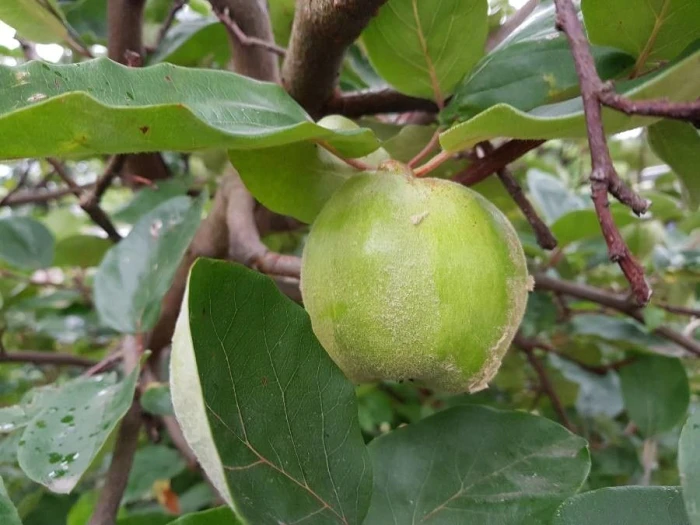
Cydonia oblonga, commonly known as Quince, is a deciduous shrub or small tree native to rocky slopes and woodland margins in Western and Central Asia. It typically grows 5 to 8 meters (16 to 26 feet) high and 4 to 6 meters (13 to 20 feet) wide. The quince tree is known for its hard, aromatic bright golden-yellow pome fruit, which is similar in appearance to a pear. The fruit measures 70 to 120 mm (3 to 4+1⁄2 in) long and 60 to 90 mm (2+1⁄2 to 3+1⁄2 in) across. Before maturity in late autumn, the immature fruit is green with dense grey-white fine hair, which mostly rubs off as the fruit ripens to a yellow color with hard, strongly perfumed flesh. The flowers are white or pink, 50 mm (2 in) across, with five petals, and bloom in spring after the leaves emerge.
Quince is valued for its ornamental flowers, fragrant fruit, and minimal maintenance requirements. It is often used in urban plantings, as a border shrub, or for espalier. The plant is hardy and drought-tolerant, adapting to various soils with low to medium pH. It thrives in both shade and sun, although full sunlight is necessary for producing larger flowers and ensuring fruit ripening. Quince is cultivated globally in warm-temperate and temperate climates, requiring a cooler period with temperatures below 7 °C (45 °F) to flower properly. Propagation is typically through cuttings or layering. Fruits are left on the tree to ripen fully and are harvested in late autumn, before the first frosts. In cultivation, quince performs best in full sun or part shade, with medium water requirements, and in soils with fast or medium drainage. While generally robust, quince can occasionally suffer from pests like codling moth or diseases such as fire blight.CC BY-SA 4.0
Quince is valued for its ornamental flowers, fragrant fruit, and minimal maintenance requirements. It is often used in urban plantings, as a border shrub, or for espalier. The plant is hardy and drought-tolerant, adapting to various soils with low to medium pH. It thrives in both shade and sun, although full sunlight is necessary for producing larger flowers and ensuring fruit ripening. Quince is cultivated globally in warm-temperate and temperate climates, requiring a cooler period with temperatures below 7 °C (45 °F) to flower properly. Propagation is typically through cuttings or layering. Fruits are left on the tree to ripen fully and are harvested in late autumn, before the first frosts. In cultivation, quince performs best in full sun or part shade, with medium water requirements, and in soils with fast or medium drainage. While generally robust, quince can occasionally suffer from pests like codling moth or diseases such as fire blight.CC BY-SA 4.0
Plant Description
- Plant Type: Tree, Shrub
- Height: 5-16 feet
- Width: 9-12 feet
- Growth Rate: Slow
- Flower Color: Pink, White
- Flowering Season: Spring
- Leaf Retention: Deciduous
Growth Requirements
- Sun: Full Sun, Part Shade
- Drainage: Fast, Medium
Common Uses
Bee Garden, Bird Garden, Butterfly Garden, Edible*Disclaimer: Easyscape's listed plant edibility is for informational use. Always verify the safety and proper identification of any plant before consumption., Fragrant, Showy Flowers
Natural Habitat
Rocky slopes and woodland margins in Western and Central Asia
Other Names
Common Names: Quitte, Quittenbaum, Echte Quitte, Membrillero, Membrillo, Cognassier, Coing, Marmelo, Kvitten, Ajva
Scientific Names: Cydonia oblonga, Cydonia vulgaris, Pyrus cydonia, Pyrus ×malifolia, Cydonia maliformis, Cydonia lusitanica, Cydonia oblonga var. maliformis, Sorbus cydonia, Cydonia communis, Cydonia oblonga f. lusitanica
GBIF Accepted Name: Cydonia oblonga Mill.