Little Mouse-Ear
/
(Cerastium semidecandrum)
Little Mouse-Ear (Cerastium semidecandrum)
/



© Alexis
CC BY 4.0

Image By:
© Alexis
Recorded By:
Copyright:
CC BY 4.0
Copyright Notice:
Photo by: © Alexis | License Type: CC BY 4.0 | License URL: http://creativecommons.org/licenses/by/4.0/ | Uploader: alexis_orion | Publisher: iNaturalist |






Summary
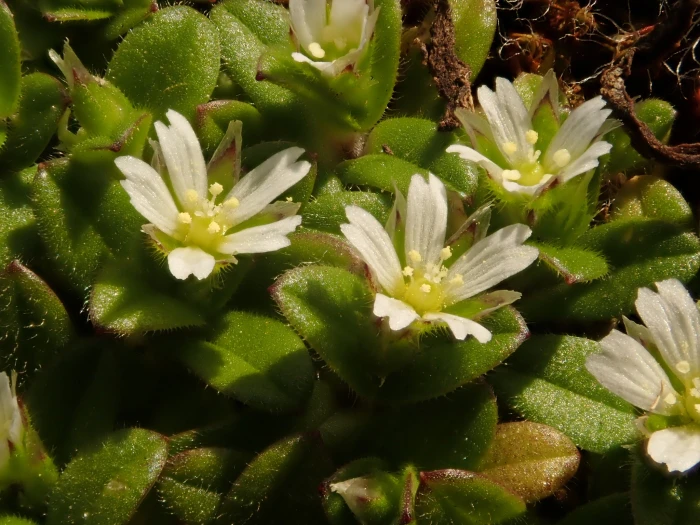
Cerastium semidecandrum, commonly known as Little Mouse-ear, is an annual herb native to a variety of habitats in Europe, Asia, and North Africa, including open fields, grasslands, and disturbed sites such as arable land, gardens, and roadsides. It is a low-growing plant, typically reaching 0.1-0.5 feet (0.03-0.2 meters) in both height and width, with a mat-forming habit. The plant features small, ovate leaves and bears white, star-shaped flowers with five notched petals and prominent stamens, blooming profusely in the spring and early summer. The flowers are modest in size but can be quite numerous, creating a delicate carpet of white.
Little Mouse-ear is appreciated for its ability to fill in bare spots in the garden and its ease of care. It is often used as a ground cover or in rock gardens due to its low stature and spreading nature. It thrives in full sun but can tolerate partial shade, and it prefers medium or fast-draining soils, including clay, loam, or sandy types. Gardeners should be aware that Cerastium semidecandrum can self-seed and spread, potentially becoming invasive in some regions. It is advisable to check local guidelines before planting to prevent unwanted spread.CC BY-SA 4.0
Little Mouse-ear is appreciated for its ability to fill in bare spots in the garden and its ease of care. It is often used as a ground cover or in rock gardens due to its low stature and spreading nature. It thrives in full sun but can tolerate partial shade, and it prefers medium or fast-draining soils, including clay, loam, or sandy types. Gardeners should be aware that Cerastium semidecandrum can self-seed and spread, potentially becoming invasive in some regions. It is advisable to check local guidelines before planting to prevent unwanted spread.CC BY-SA 4.0
Plant Description
- Plant Type: Herb
- Height: 0.1-0.5 feet
- Width: 0.1-0.5 feet
- Growth Rate: Slow, Moderate
- Flower Color: White
- Flowering Season: Spring, Summer
- Leaf Retention:
Growth Requirements
- Sun: Full Sun
- Drainage: Medium, Fast
Common Uses
Low Maintenance
Natural Habitat
Open fields, grasslands, and disturbed sites such as arable land, gardens, and roadsides
Other Names
Common Names: Little Mouse-ear, Lesser Mouse-ear Chickweed, Five-Stamen Mouse-Ear Chickweed
Scientific Names: Cerastium semidecandrum, ? abortivum, Alsine pellucida, Centunculus semidecandrus, Cerastium anomalum, Cerastium arenarium, Cerastium balearicum, Cerastium breviflorum, Cerastium dentatum
GBIF Accepted Name: Cerastium semidecandrum