Mouse-Ear Chickweed
/
(Cerastium fontanum)
Mouse-Ear Chickweed (Cerastium fontanum)
/



© Julia Palmer
CC BY-SA 4.0

Image By:
© Julia Palmer
Recorded By:
Copyright:
CC BY-SA 4.0
Copyright Notice:
Photo by: © Julia Palmer | License Type: CC BY-SA 4.0 | License URL: http://creativecommons.org/licenses/by-sa/4.0/ | Uploader: jupal04 | Publisher: iNaturalist |



Summary
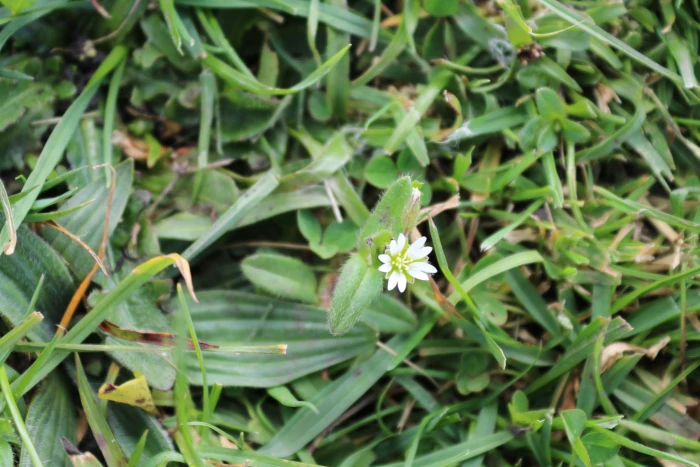
Cerastium fontanum, commonly known as Mouse-ear Chickweed or Common Mouse-ear, is a mat-forming perennial herb native to a wide range of habitats in Europe, including meadows, grassy slopes, and open woodlands. It has been introduced worldwide. This plant typically grows 4-8 inches tall and features hairy, tear-shaped leaves. The small, white, five-petaled flowers bloom from late spring to early summer and are considered modestly showy. Mouse-ear Chickweed spreads to form dense mats, which can be beneficial as a ground cover in garden settings.
Mouse-ear Chickweed is valued for its low maintenance and ability to cover ground quickly, making it suitable for rock gardens, borders, and as a filler in garden beds. It thrives in full sun to part shade and prefers well-drained soils but can tolerate a range of soil conditions, including poor soils. Gardeners should be aware that it can become aggressive and potentially invasive outside its native range, so it is important to manage its spread to prevent it from outcompeting other plants.CC BY-SA 4.0
Mouse-ear Chickweed is valued for its low maintenance and ability to cover ground quickly, making it suitable for rock gardens, borders, and as a filler in garden beds. It thrives in full sun to part shade and prefers well-drained soils but can tolerate a range of soil conditions, including poor soils. Gardeners should be aware that it can become aggressive and potentially invasive outside its native range, so it is important to manage its spread to prevent it from outcompeting other plants.CC BY-SA 4.0
Plant Description
- Plant Type: Herb
- Height: 0.5-1.5 feet
- Width: 1.5-2 feet
- Growth Rate: Moderate, Rapid
- Flower Color: White
- Flowering Season: Spring, Summer
- Leaf Retention: Deciduous
Growth Requirements
- Sun: Full Sun
- Drainage: Fast, Medium, Slow
Common Uses
Low Maintenance
Natural Habitat
Meadows, grassy slopes, and open woodlands
Other Names
Common Names: Mouse-Ear Chickweed, Large Mouse-Ear, Common Mouse-Ear, Common Mouse-Ear Chickweed, Big Chickweed
Scientific Names: Starweed
GBIF Accepted Name: Cerastium fontanum