Japanese Sedge
/
(Carex kobomugi)
Japanese Sedge (Carex kobomugi)
/



harum.koh
CC BY-SA 4.0

Image By:
harum.koh
Recorded By:
Copyright:
CC BY-SA 4.0
Copyright Notice:
Photo by: harum.koh | License Type: CC BY-SA 4.0 | License URL: http://creativecommons.org/licenses/by-sa/4.0/ | Rights Holder: harum.koh | Publisher: iNaturalist | Date Created: 2015-07-19T14:14:10-07:00 |



Summary
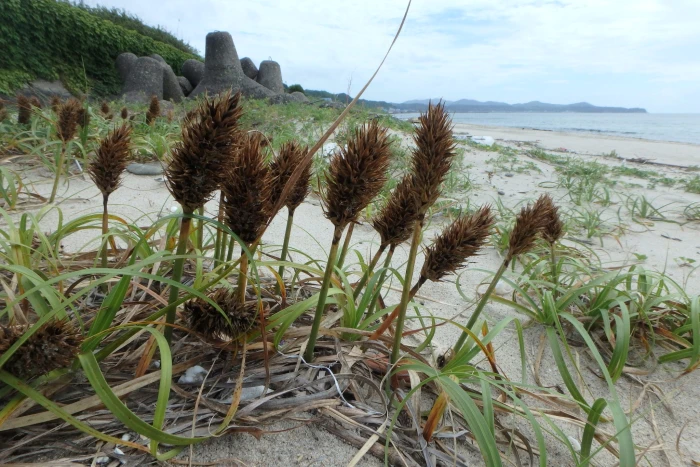
Carex kobomugi, commonly known as Japanese sedge or Asiatic sand sedge, is a perennial herbaceous plant native to coastal dunes and sandy shores of eastern Asia, including Japan, Korea, and China. It forms dense mats of foliage, typically reaching up to 12 inches in height. The leaves are narrow and grass-like, and the plant is dioecious, with separate male and female flower spikes. Flowering occurs in late spring to early summer, with the spikes being relatively inconspicuous compared to the foliage. In its native habitat, it stabilizes sand dunes and prevents erosion.
Japanese sedge is known for its ability to spread rapidly through rhizomes, making it a tough and resilient ground cover in coastal gardens. However, it has become an invasive species in the northeastern United States, where it outcompetes native flora and alters coastal ecosystems. It is banned for sale and distribution in some U.S. states due to its invasive nature. When cultivated, it requires well-drained sandy soils and full sun to part shade. It is drought-tolerant once established and requires minimal maintenance. It is invasive along the U.S. Atlantic coast from Rhode Island to North Carolina, spreading through rhizomes and buoyant seeds.CC BY-SA 4.0
Japanese sedge is known for its ability to spread rapidly through rhizomes, making it a tough and resilient ground cover in coastal gardens. However, it has become an invasive species in the northeastern United States, where it outcompetes native flora and alters coastal ecosystems. It is banned for sale and distribution in some U.S. states due to its invasive nature. When cultivated, it requires well-drained sandy soils and full sun to part shade. It is drought-tolerant once established and requires minimal maintenance. It is invasive along the U.S. Atlantic coast from Rhode Island to North Carolina, spreading through rhizomes and buoyant seeds.CC BY-SA 4.0
Plant Description
- Plant Type: Grass
- Height: 1-2 feet
- Width: 1-1.6 feet
- Growth Rate: Slow
- Flower Color: N/A
- Flowering Season: Summer
- Leaf Retention: Evergreen
Growth Requirements
- Sun: Full Sun, Part Shade
- Drainage: Fast, Medium
Common Uses
Bank Stabilization, Erosion Control, Low Maintenance, Salt Tolerant
Natural Habitat
Coastal dunes and sandy shores of eastern Asia
Other Names
Common Names: Kobomugi, Japanese Sedge, Fude-Kusa, Shai Cao
Scientific Names: Asiatic Sand Sedge
GBIF Accepted Name: Carex kobomugi