Cupseed
/
(Calycocarpum lyonii)
Cupseed (Calycocarpum lyonii)
/


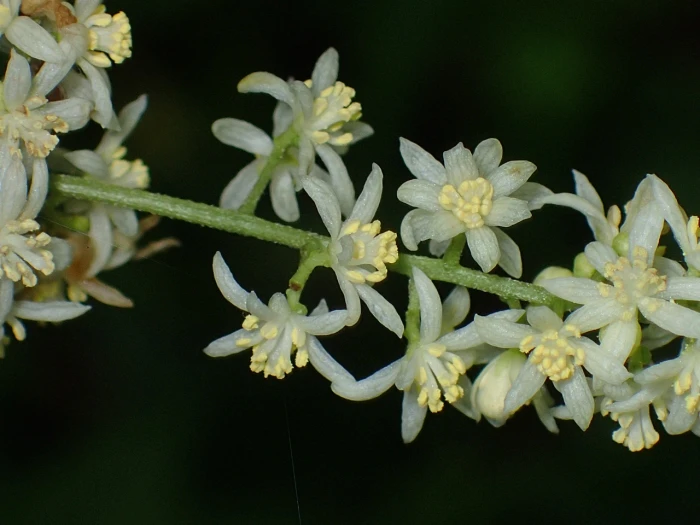

John P Friel
CC BY 4.0

Image By:
John P Friel
Recorded By:
Copyright:
CC BY 4.0
Copyright Notice:
Photo by: John P Friel | License Type: CC BY 4.0 | License URL: http://creativecommons.org/licenses/by/4.0/ | Rights Holder: John P Friel | Publisher: iNaturalist | Date Created: 2018-05-25T11:55:28-07:00 |



Summary
Calycocarpum lyonii, commonly known as Cupseed, is a deciduous vine endemic to the southeastern United States, including Texas, Louisiana, Oklahoma, Arkansas, southeastern Kansas, Missouri, southern Illinois, southern Indiana, Kentucky, Tennessee, Mississippi, Alabama, Georgia, northwestern Florida, and southern South Carolina. It is typically found in the understory of deciduous forests along stream banks and floodplains at elevations below 1148 feet (350 meters), where it climbs over other vegetation, often reaching the tops of tall forest trees. Cupseed can grow vigorously, with broad, pentagonally lobed leaves that are up to 12 inches across and 10 inches long. Its flowers are small, yellow-green, and borne in racemes or panicles up to 14 inches long, blooming in late spring to early summer.
Cupseed is not widely cultivated but can be used in naturalistic plantings, especially in areas mimicking its native riparian habitats. It thrives in moist, well-drained soils and can tolerate partial shade to full sun. While not known for a particular disease, it can become quite large and may require management to prevent it from overgrowing other plants. Cupseed is valued for its ability to stabilize soil in erosion-prone areas due to its vigorous growth habit.CC BY-SA 4.0
Cupseed is not widely cultivated but can be used in naturalistic plantings, especially in areas mimicking its native riparian habitats. It thrives in moist, well-drained soils and can tolerate partial shade to full sun. While not known for a particular disease, it can become quite large and may require management to prevent it from overgrowing other plants. Cupseed is valued for its ability to stabilize soil in erosion-prone areas due to its vigorous growth habit.CC BY-SA 4.0
Plant Description
- Plant Type: Vine
- Height: 50-80 feet
- Width: 10-20 feet
- Growth Rate: Rapid
- Flower Color: White
- Flowering Season: Spring, Summer
- Leaf Retention: Deciduous
Growth Requirements
- Sun: Part Shade, Full Shade
- Drainage: Medium
Common Uses
Bird Garden, Low Maintenance, Water Garden
Natural Habitat
Native to the understory of deciduous forests along stream banks and floodplains in the southeastern United States
Other Names
Common Names: Lyon’s Cupseed, Pumpkin Ash, Lyon’s Calycocarpum
Scientific Names: Calycocarpum lyonii, Calycocarpum lyonii, Menispermum dubium, Menispermum dubium, Menispermum lyonii
GBIF Accepted Name: Calycocarpum lyonii