Angel’s Trumpet
/
(Brugmansia suaveolens)
Angel’s Trumpet (Brugmansia suaveolens)
/


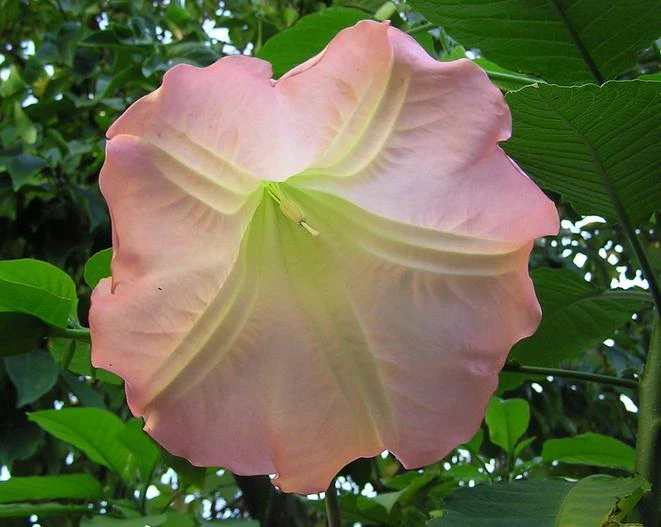

Robert
CC BY-SA 2.0

Image By:
Robert
Recorded By:
Copyright:
CC BY-SA 2.0
Copyright Notice:
Photo by: Robert | License Type: CC BY-SA 2.0 | License URL: https://creativecommons.org/licenses/by-sa/2.0/ | Uploader: RobertStok | Publisher: Flickr





Summary
Brugmansia suaveolens, commonly known as White Angel's Trumpet, is an evergreen shrub or small tree native to the tropical regions of South America. It typically grows to a height of 3-8 feet (0.9-2.4 meters) and a width of 2-4 feet (0.6-1.2 meters). This plant is renowned for its large, pendulous flowers that come in shades of yellow, pink, and white, blooming profusely in the summer and fall. The flowers are highly fragrant, especially in the evening, adding to its ornamental value. White Angel's Trumpet has a bushy form and often features a woody stem with large, oval leaves that provide a lush, tropical appearance.
White Angel's Trumpet is valued for its dramatic, trumpet-shaped flowers and sweet fragrance, making it a popular choice for ornamental gardens, patios, and as a container plant. It thrives in warm climates and is often used to create a focal point in a garden due to its showy blooms. In cultivation, it requires organically rich, well-draining soil, consistent moisture, and regular feeding with a high-potassium fertilizer to support its vigorous growth and flowering. It prefers full sun to partial shade and should be sheltered from strong winds. While it can be grown in temperate regions, it requires protection from frost and may be overwintered indoors. Propagation is typically done through woody or leafy tip cuttings. Gardeners should be aware that all parts of Brugmansia suaveolens are toxic if ingested, and it should be planted with caution around children and pets. It is invasive in New Caledonia.CC BY-SA 4.0
White Angel's Trumpet is valued for its dramatic, trumpet-shaped flowers and sweet fragrance, making it a popular choice for ornamental gardens, patios, and as a container plant. It thrives in warm climates and is often used to create a focal point in a garden due to its showy blooms. In cultivation, it requires organically rich, well-draining soil, consistent moisture, and regular feeding with a high-potassium fertilizer to support its vigorous growth and flowering. It prefers full sun to partial shade and should be sheltered from strong winds. While it can be grown in temperate regions, it requires protection from frost and may be overwintered indoors. Propagation is typically done through woody or leafy tip cuttings. Gardeners should be aware that all parts of Brugmansia suaveolens are toxic if ingested, and it should be planted with caution around children and pets. It is invasive in New Caledonia.CC BY-SA 4.0
Plant Description
- Plant Type: Tree, Shrub
- Height: 3-8 feet
- Width: 2-4 feet
- Growth Rate: Moderate
- Flower Color: Yellow, Pink, White
- Flowering Season: Summer, Fall
- Leaf Retention: Evergreen
Growth Requirements
- Sun: Full Sun
- Drainage: Medium
Common Uses
Bee Garden, Bird Garden, Butterfly Garden, Deer Resistant, Fragrant, Hummingbird Garden, Showy Flowers
Natural Habitat
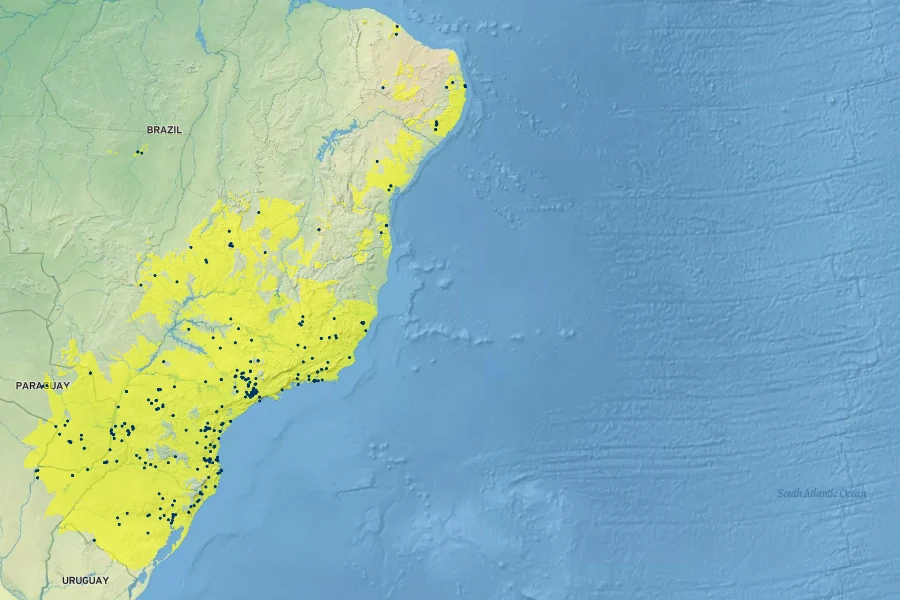
Native to the tropical regions of South America
Other Names
Common Names: Brazil’s White Angel Trumpet, Snowy Angel’s Trumpet, White Angel’s-Trumpet, Angel’s-Trumpet, Duftende Engelstrompete, Änglatrumpet, Campana, Campana De Paris, Campana De Rio, Floripondio
Scientific Names: Brugmansia suaveolens, Datura arborea, Datura suaveolens, Datura suaveolens var. macrocalyx, Datura gardneri, Pseudodatura suaveolens
GBIF Accepted Name: Brugmansia suaveolens (Humb. & Bonpl. ex Willd.) Bercht. & J.Presl