Willow Ragwort
/
(Barkleyanthus salicifolius)
Willow Ragwort (Barkleyanthus salicifolius)
/


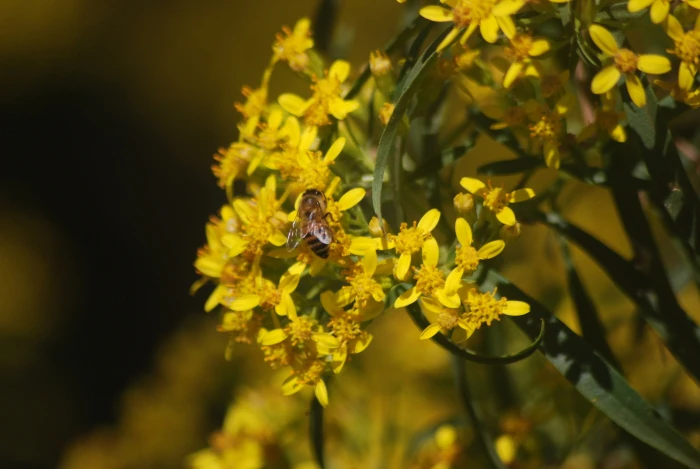

Leslie Alanís
CC BY 4.0

Image By:
Leslie Alanís
Recorded By:
Copyright:
CC BY 4.0
Copyright Notice:
Photo by: Leslie Alanís | License Type: CC BY 4.0 | License URL: http://creativecommons.org/licenses/by/4.0/ | Rights Holder: Leslie Alanís | Publisher: iNaturalist | Date Created: 2021-03-15T11:01:50-07:00 |



Summary
Barkleyanthus salicifolius, commonly known as Willow Ragwort, is an evergreen or semi-deciduous shrub native to riparian zones, floodplains, and semi-arid plains in the Southwestern USA and Mexico. It typically grows to a height of one to two meters but can occasionally exceed four meters. The shrub has a branching habit with lance-shaped leaves that are alternately arranged, sometimes clustering more densely at the ends of branches, and can be up to 10 or 15 centimeters long. The inflorescence comprises several flower heads that may also cluster in the leaf axils or branch tips. Each head features a few yellow ray florets, which are pistillate, and numerous yellow disc florets, which are bisexual. The fruit is a rough-textured cypsela, pyramidal or prism-shaped, up to a centimeter long including its pappus of barbed white bristles. Willow Ragwort flowers year-round, with a peak in spring, and is particularly showy at the end of the dry season.
Willow Ragwort is valued for its bright yellow flower heads and is often used as an ornamental plant in xeriscaping due to its drought tolerance. It prefers soils with medium to fast drainage. While it is generally easy to maintain, it can be susceptible to root rot if overwatered. This plant is not commonly associated with significant diseases or aggressive roots, making it a reliable choice for gardeners. Its ability to flower during dry periods makes it a valuable source of color when other plants may not be blooming.CC BY-SA 4.0
Willow Ragwort is valued for its bright yellow flower heads and is often used as an ornamental plant in xeriscaping due to its drought tolerance. It prefers soils with medium to fast drainage. While it is generally easy to maintain, it can be susceptible to root rot if overwatered. This plant is not commonly associated with significant diseases or aggressive roots, making it a reliable choice for gardeners. Its ability to flower during dry periods makes it a valuable source of color when other plants may not be blooming.CC BY-SA 4.0
Plant Description
- Plant Type: Shrub
- Height: 4-8 feet
- Width: 4-8 feet
- Growth Rate: Moderate
- Flower Color: Yellow
- Flowering Season: Spring, Summer, Fall
- Leaf Retention: Evergreen, Semi-deciduous
Growth Requirements
- Sun: Full Sun
- Drainage: Medium, Fast
Common Uses
Bee Garden, Bird Garden, Border Plant, Butterfly Garden, Low Maintenance, Potted Plant
Natural Habitat
Native to riparian zones, floodplains, and semi-arid plains in the Southwestern USA and Mexico
Other Names
Common Names:
Scientific Names: Senecio salignus, Barkleyanthus salicifolius, Cineraria angustifolia, Cineraria salicifolia, Senecio axillaris, Senecio vernus, Cacalia angustifolia var. angustifolia, Cineraria dracunculoides, Cineraria verna
GBIF Accepted Name: Barkleyanthus salicifolius (Kunth) H.Rob. & Brettell