Gardner’s Saltbush
/
(Atriplex gardneri var. falcata)
Gardner’s Saltbush (Atriplex gardneri var. falcata)
/



Matt Lavin
CC BY-SA 2.0

Image By:
Matt Lavin
Recorded By:
Copyright:
CC BY-SA 2.0
Copyright Notice:
Photo by: Matt Lavin | License Type: CC BY-SA 2.0 | License URL: https://creativecommons.org/licenses/by-sa/2.0/ | Uploader: Matt Lavin | Publisher: Flickr



Summary
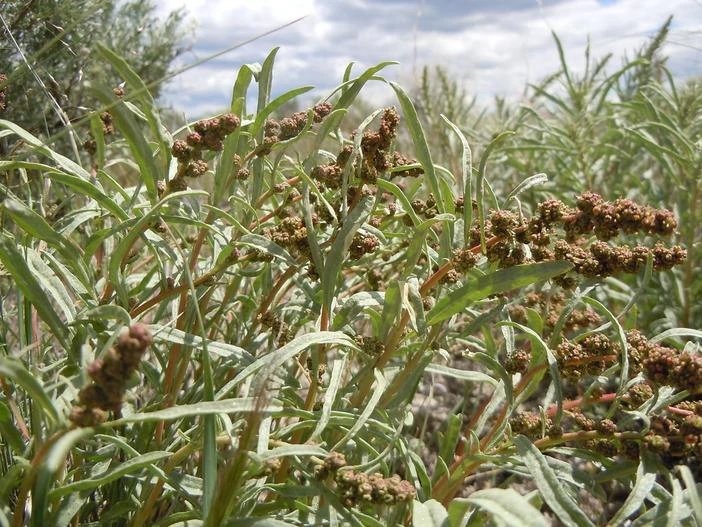
Atriplex gardneri var. falcata, commonly known as Sickle Saltbush, is a perennial herb native to the Great Basin and surrounding areas of the Western United States. It thrives in arid environments, including semi-deserts, canyons, and valleys, often in saline or alkaline soils. This plant exhibits a moderate growth rate, typically reaching 1-3 feet (0.3-0.9 meters) in both height and width. Sickle Saltbush has a sprawling form with green or yellow flowers that are small and inconspicuous, blooming in the summer. The foliage is gray-green and can be quite dense, providing good ground cover.
Sickle Saltbush is valued for its drought tolerance and ability to thrive in challenging soil conditions, making it an excellent choice for xeriscaping and restoration projects in arid regions. It is also used for erosion control and as wildlife habitat, offering cover and forage for animals. In cultivation, it requires full sun exposure and can tolerate a range of soil types, including clay, loam, and sandy soils, as long as they have medium to fast drainage. It is a low-maintenance plant that requires minimal water once established. While it is not known for significant pest or disease issues, it can spread somewhat aggressively in favorable conditions.CC BY-SA 4.0
Sickle Saltbush is valued for its drought tolerance and ability to thrive in challenging soil conditions, making it an excellent choice for xeriscaping and restoration projects in arid regions. It is also used for erosion control and as wildlife habitat, offering cover and forage for animals. In cultivation, it requires full sun exposure and can tolerate a range of soil types, including clay, loam, and sandy soils, as long as they have medium to fast drainage. It is a low-maintenance plant that requires minimal water once established. While it is not known for significant pest or disease issues, it can spread somewhat aggressively in favorable conditions.CC BY-SA 4.0
Plant Description
- Plant Type: Herb, Shrub
- Height: 1-3 feet
- Width: 1-3 feet
- Growth Rate: Moderate
- Flower Color: Green, Yellow
- Flowering Season: Summer
- Leaf Retention: Deciduous
Growth Requirements
- Sun: Full Sun
- Drainage: Medium, Fast
Common Uses
Drought Tolerant, Erosion Control, Low Maintenance, Salt Tolerant
Natural Habitat
Great Basin and surrounding areas of the Western United States, often in semi-deserts, canyons, and valleys with saline or alkaline soils
Other Names
Common Names: Gardner’s saltbush, Sickle Saltbush, Jones’ Saltbush, Falcate orach
Scientific Names: Atriplex gardneri var. falcata, Atriplex falcata, Atriplex nuttallii subsp. falcata, Atriplex nuttallii var. falcata, Obione falcata
GBIF Accepted Name: Atriplex gardneri var. falcata