Purple Milkvetch
/
(Astragalus agrestis)
Purple Milkvetch (Astragalus agrestis)
/


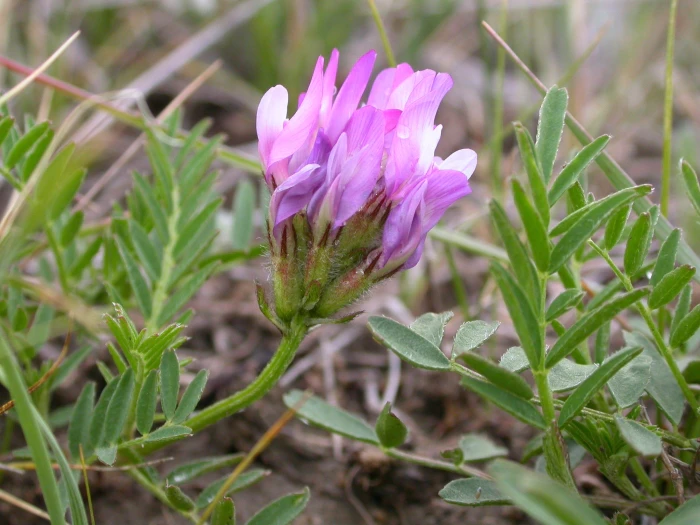

Matt Lavin
CC BY 4.0

Image By:
Matt Lavin
Recorded By:
Copyright:
CC BY 4.0
Copyright Notice:
Photo by: Matt Lavin | License Type: CC BY 4.0 | License URL: http://creativecommons.org/licenses/by/4.0/ | Rights Holder: Matt Lavin | Publisher: iNaturalist | Date Created: 2005-05-17T18:13:21-07:00 |






Summary
Astragalus agrestis, commonly known as purple milkvetch, is a perennial herb native to a variety of habitats including open woodlands, grasslands, and sagebrush steppe in western and northern North America, as well as eastern Asia. It thrives in vernally moist areas, often in meadows or along streambanks, where the soil is well-drained. Typically, this species reaches up to 12 inches in height and features a slender but sturdy stem. The leaves are pinnately compound with several pairs of oval to lance-shaped leaflets arranged alternately along the stem. From May to August, it produces an inflorescence consisting of a cluster of up to 15 flowers, which are notable for their purple or pink tint. Following flowering, the plant forms a distinctive dark-colored, hairy legume pod.
Purple milkvetch is valued for its ability to fix nitrogen in the soil, enhancing soil fertility, and for its attractive flowers which can add color to naturalistic plantings and wildflower gardens. It is also used in restoration projects to stabilize soils and promote biodiversity. In cultivation, purple milkvetch requires minimal maintenance, preferring full sun to partial shade and tolerating a range of soil types, provided they are well-drained. While generally disease-resistant, it can be susceptible to root rot in overly wet conditions. There are no widely known popular garden cultivars of this species.CC BY-SA 4.0
Purple milkvetch is valued for its ability to fix nitrogen in the soil, enhancing soil fertility, and for its attractive flowers which can add color to naturalistic plantings and wildflower gardens. It is also used in restoration projects to stabilize soils and promote biodiversity. In cultivation, purple milkvetch requires minimal maintenance, preferring full sun to partial shade and tolerating a range of soil types, provided they are well-drained. While generally disease-resistant, it can be susceptible to root rot in overly wet conditions. There are no widely known popular garden cultivars of this species.CC BY-SA 4.0
Plant Description
- Plant Type: Herb
- Height: 0.5-2 feet
- Width: 0.5-1 feet
- Growth Rate: Moderate
- Flower Color: Purple
- Flowering Season: Spring, Summer
- Leaf Retention: Deciduous
Growth Requirements
- Sun: Full Sun, Part Shade
- Drainage: Medium
Common Uses
Bee Garden, Butterfly Garden, Erosion Control, Low Maintenance
Natural Habitat
Native to open woodlands, grasslands, and sagebrush steppe in western and northern North America, and eastern Asia
Other Names
Common Names: Field Milkvetch, Purple Milkvetch, Meadow Milk-Vetch, Wild Milk-Vetch
Scientific Names: Astragalus agrestis, Astragalus agrestis f. agrestis, Astragalus agrestis f. virgultulus, Astragalus agrestis f. virgultulus, Astragalus agrestis var. bracteatus, Astragalus agrestis var. polyspermus, Astragalus danicus f. virgultulus, Astragalus danicus subsp. dasyglottis, Astragalus danicus var. dasyglottis
GBIF Accepted Name: Astragalus agrestis