Budsage
/
(Artemisia spinescens)
Budsage (Artemisia spinescens)
/


Jim Morefield
CC BY 4.0

Image By:
Jim Morefield
Recorded By:
Copyright:
CC BY 4.0
Copyright Notice:
Photo by: Jim Morefield | License Type: CC BY 4.0 | License URL: http://creativecommons.org/licenses/by/4.0/ | Rights Holder: Jim Morefield | Publisher: iNaturalist | Date Created: 2019-04-20T14:28:47-07:00 |





Summary
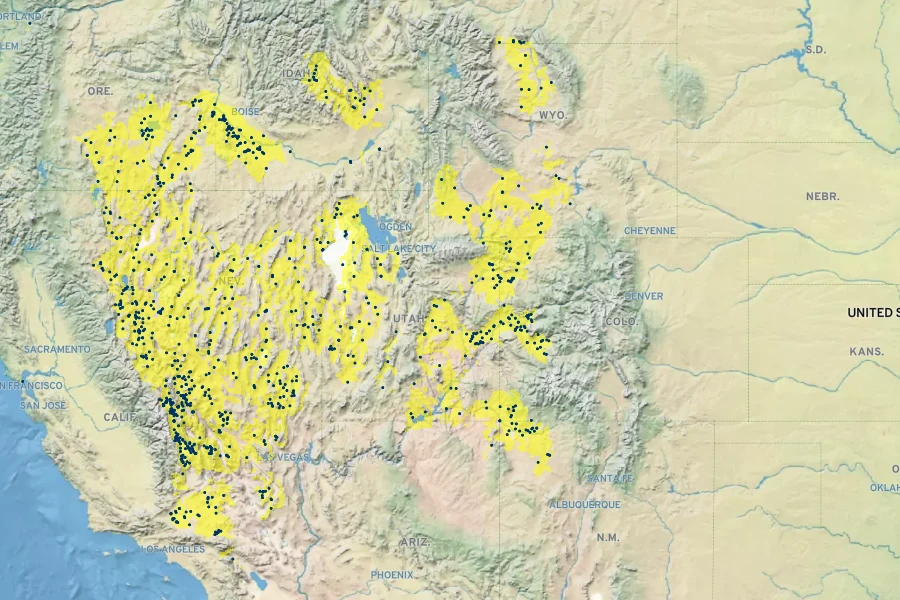
Artemisia spinescens, commonly known as budsage, is a perennial shrub native to arid and semi-arid regions, specifically the sagebrush steppe and desert shrub communities in the western United States. Its range includes California, the Great Basin, Idaho, Montana, Colorado, and northwestern New Mexico. Budsage typically grows in dry, saline to alkaline soils, often in association with other salt-tolerant species such as saltbushes (Atriplex spp.). This plant is well-adapted to its harsh native environment, characterized by hot, dry summers and cold winters.
Budsage forms a compact, rounded bush reaching up to 20 inches in height, with spiny, silvery-gray, aromatic foliage that is a hallmark of many Artemisia species. The leaves contain bitter volatile oils, which can deter herbivory. While it is not widely used in ornamental horticulture, budsage can be valuable in xeriscaping and habitat restoration projects due to its drought tolerance and ability to thrive in poor soils. It requires minimal water once established, prefers full sun, and is suitable for well-drained soils. In the wild, budsage provides early-season forage for grazing animals, though its palatability decreases as the season progresses due to the increasing concentration of bitter oils in the leaves. There are no major diseases or pests associated with this plant, but it may not compete well in areas with high competition from non-native species.CC BY-SA 4.0
Budsage forms a compact, rounded bush reaching up to 20 inches in height, with spiny, silvery-gray, aromatic foliage that is a hallmark of many Artemisia species. The leaves contain bitter volatile oils, which can deter herbivory. While it is not widely used in ornamental horticulture, budsage can be valuable in xeriscaping and habitat restoration projects due to its drought tolerance and ability to thrive in poor soils. It requires minimal water once established, prefers full sun, and is suitable for well-drained soils. In the wild, budsage provides early-season forage for grazing animals, though its palatability decreases as the season progresses due to the increasing concentration of bitter oils in the leaves. There are no major diseases or pests associated with this plant, but it may not compete well in areas with high competition from non-native species.CC BY-SA 4.0
Plant Description
- Plant Type: Shrub
- Height: 1-3 feet
- Width: 1-3 feet
- Growth Rate: Slow
- Flower Color: Yellow
- Flowering Season: Summer
- Leaf Retention: Deciduous
Growth Requirements
- Sun: Full Sun
- Drainage: Medium, Fast
Common Uses
Drought Tolerant, Erosion Control, Low Maintenance
Natural Habitat
Native to arid and semi-arid regions, specifically sagebrush steppe and desert shrub communities
Other Names
Common Names: Spiny Sagebrush, Gray Sagebrush
Scientific Names: Artemisia spinescens, Picrothamnus desertorum
GBIF Accepted Name: Artemisia spinescens