Indian Birthwort
/
(Aristolochia indica)
Indian Birthwort (Aristolochia indica)
/


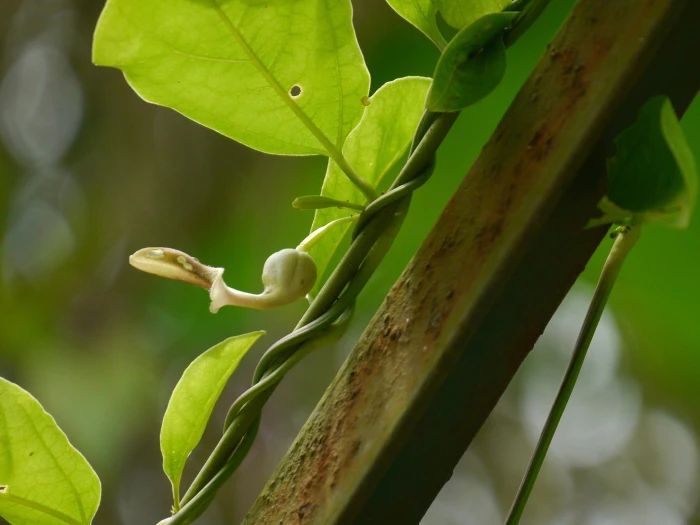

© Dinesh Valke
CC BY-SA 4.0

Image By:
© Dinesh Valke
Recorded By:
Copyright:
CC BY-SA 4.0
Copyright Notice:
Photo by: © Dinesh Valke | License Type: CC BY-SA 4.0 | License URL: http://creativecommons.org/licenses/by-sa/4.0/ | Uploader: dineshvalke | Publisher: iNaturalist |



Summary
Aristolochia indica, commonly known as Indian Birthwort, Garudakkodi, or Eswaramooli, is a perennial herbaceous vine native to tropical and subtropical regions of Southern India and Sri Lanka. It typically thrives in the understory of moist deciduous forests, often on forest floors and rocky hillslopes, where it forms part of the ecological niche supporting various forms of wildlife, including being a host plant for the larvae of certain butterfly species such as the Common Birdwing.
Indian Birthwort has heart-shaped leaves and peculiar pipe-shaped flowers that are yellowish-brown, often with a purplish tinge, which bloom intermittently throughout the year. The flowers are not particularly showy but are of interest due to their unique shape. The plant is known for its traditional medicinal uses, particularly in Ayurveda, despite containing toxic aristolochic acid. It is sometimes cultivated in herbal gardens and used in traditional medicine for its purported health benefits, which include anti-inflammatory and antimicrobial properties. In cultivation, Aristolochia indica prefers partial shade to full shade, moist but well-drained soils, and does not require a lot of water once established. It can be propagated by seeds or stem cuttings. Gardeners should handle this plant with care due to its toxic properties and be aware of its potential to spread if conditions are favorable. It is not commonly used in ornamental horticulture due to its toxicity and the non-showy nature of its flowers.CC BY-SA 4.0
Indian Birthwort has heart-shaped leaves and peculiar pipe-shaped flowers that are yellowish-brown, often with a purplish tinge, which bloom intermittently throughout the year. The flowers are not particularly showy but are of interest due to their unique shape. The plant is known for its traditional medicinal uses, particularly in Ayurveda, despite containing toxic aristolochic acid. It is sometimes cultivated in herbal gardens and used in traditional medicine for its purported health benefits, which include anti-inflammatory and antimicrobial properties. In cultivation, Aristolochia indica prefers partial shade to full shade, moist but well-drained soils, and does not require a lot of water once established. It can be propagated by seeds or stem cuttings. Gardeners should handle this plant with care due to its toxic properties and be aware of its potential to spread if conditions are favorable. It is not commonly used in ornamental horticulture due to its toxicity and the non-showy nature of its flowers.CC BY-SA 4.0
Plant Description
- Plant Type: Vine
- Height: 3-6 feet
- Width: 2-4 feet
- Growth Rate: Moderate
- Flower Color: Green, Purple
- Flowering Season: Summer
- Leaf Retention: Deciduous
Growth Requirements
- Sun: Full Sun, Part Shade
- Drainage: Medium
Common Uses
Butterfly Garden, Low Maintenance, Showy Flowers
Natural Habitat
Moist deciduous forests, often on forest floors and rocky hillslopes
Other Names
Common Names: Duck Flower
Scientific Names: Aristolochia indica, Aristolochia indica var. lanceolata, Aristolochia indica var. magna, Aristolochia indica var. oxyphylla, Aristolochia lanceolata, Aristolochia maysorensis, Aristolochia maysorensis, Aristolochia pandurata, Aristolochia pandurata
GBIF Accepted Name: Aristolochia indica