Eastwood’s Fiddleneck
/
(Amsinckia eastwoodiae)
Eastwood’s Fiddleneck (Amsinckia eastwoodiae)
/


© Lindsey Salmonson
CC BY 4.0

Image By:
© Lindsey Salmonson
Recorded By:
Copyright:
CC BY 4.0
Copyright Notice:
Photo by: © Lindsey Salmonson | License Type: CC BY 4.0 | License URL: http://creativecommons.org/licenses/by/4.0/ | Uploader: lindsey09 | Publisher: iNaturalist |





Summary
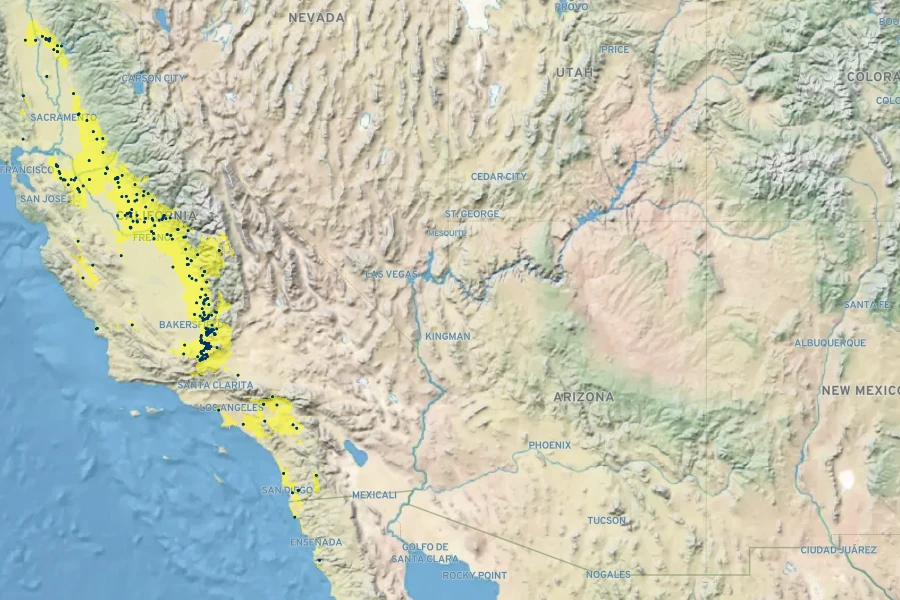
Amsinckia eastwoodiae, commonly known as Eastwood’s fiddleneck, is an annual herb endemic to California, specifically thriving in chaparral, coastal sage scrub, and grasslands, as well as disturbed areas. It is often found in the hills, mountains, valleys, and along the coastlines. This plant typically grows to a height of 1 to 3 feet and features a distinctive coiled inflorescence, resembling the neck of a fiddle, hence the common name. The inflorescences bear tubular orange flowers that are about 1 inch long and 1 inch wide at the face, blooming from March to May. The flowers are quite showy and attract a variety of pollinators.
Eastwood’s fiddleneck is appreciated for its bright, attractive blooms that add a splash of color to wildflower gardens and naturalized areas. It is relatively easy to grow from seed and can be used to fill in bare spots in a garden setting. This plant prefers full sun to part shade and is adaptable to various soil types, though it thrives in well-drained soils. While it is not commonly used for culinary or medicinal purposes, it is an important food source for native bees. Gardeners should be aware that Amsinckia species can contain pyrrolizidine alkaloids, which are toxic to livestock and humans if consumed in large quantities.CC BY-SA 4.0
Eastwood’s fiddleneck is appreciated for its bright, attractive blooms that add a splash of color to wildflower gardens and naturalized areas. It is relatively easy to grow from seed and can be used to fill in bare spots in a garden setting. This plant prefers full sun to part shade and is adaptable to various soil types, though it thrives in well-drained soils. While it is not commonly used for culinary or medicinal purposes, it is an important food source for native bees. Gardeners should be aware that Amsinckia species can contain pyrrolizidine alkaloids, which are toxic to livestock and humans if consumed in large quantities.CC BY-SA 4.0
Plant Description
- Plant Type: Herb
- Height: 1-2 feet
- Width: 0.5-1 feet
- Growth Rate: Rapid
- Flower Color: Orange, Yellow
- Flowering Season: Spring
- Leaf Retention:
Growth Requirements
- Sun: Full Sun
- Drainage: Fast
Common Uses
Bee Garden, Drought Tolerant, Low Maintenance
Natural Habitat
Chaparral, coastal sage scrub, and grasslands
Other Names
Common Names: Red Fiddleneck, Red Bells
Scientific Names: Amsinckia eastwoodiae, Amsinckia douglasiana var. eastwoodiae, Amsinckia intermedia var. eastwoodiae, Amsinckia johnstonii, Amsinckia jonesii, Amsinckia jucunda, Amsinckia obvallata, Amsinckia obvallata, Amsinckia splendens
GBIF Accepted Name: Amsinckia eastwoodiae