Amur Peppervine
/
(Ampelopsis glandulosa)
Amur Peppervine (Ampelopsis glandulosa)
/


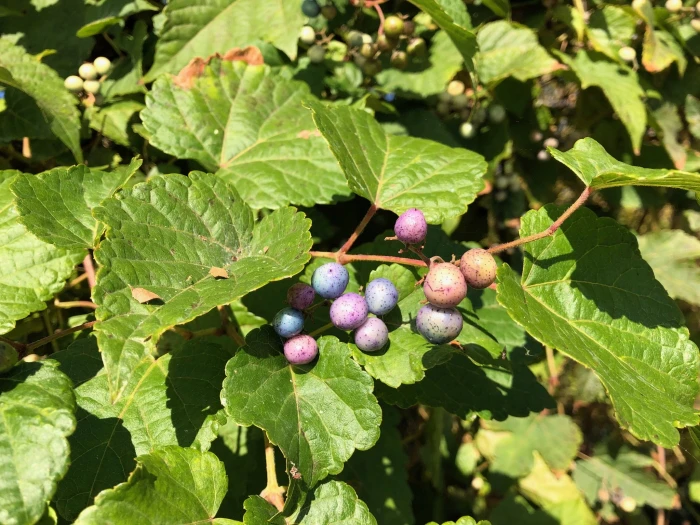

© Jason Grant
CC BY 4.0

Image By:
© Jason Grant
Recorded By:
Copyright:
CC BY 4.0
Copyright Notice:
Photo by: © Jason Grant | License Type: CC BY 4.0 | License URL: http://creativecommons.org/licenses/by/4.0/ | Uploader: jasonrgrant | Publisher: iNaturalist |






Summary
Ampelopsis glandulosa, commonly known as Amur Peppervine, is a deciduous perennial vine originally from forest margins, shrublands, and riverbanks in Asia, from Nepal to Southeast China and Taiwan. It can climb to heights of 10-20 feet (3-6.1 meters) and spread 10-15 feet (3-4.6 meters), using tendrils to attach to structures and other plants. The vine is characterized by its lush foliage and small, non-showy greenish flowers that bloom in summer, followed by clusters of ornamental berries that change from green to bright blue as they mature.
Amur Peppervine is valued for its rapid growth and ability to cover trellises, arbors, and fences, providing quick shade and privacy. It is also used for erosion control on slopes. This vine thrives in a range of light conditions, from full sun to part shade, and is adaptable to various soil types, provided they have good drainage. Gardeners should be cautious, as it can become invasive outside its native range, spreading aggressively and outcompeting native vegetation. It is advisable to check local regulations before planting and to manage its growth to prevent unwanted spread. It is invasive in the eastern United States, smothering shrubs and trees, and spreading via bird-dispersed seeds.CC BY-SA 4.0
Amur Peppervine is valued for its rapid growth and ability to cover trellises, arbors, and fences, providing quick shade and privacy. It is also used for erosion control on slopes. This vine thrives in a range of light conditions, from full sun to part shade, and is adaptable to various soil types, provided they have good drainage. Gardeners should be cautious, as it can become invasive outside its native range, spreading aggressively and outcompeting native vegetation. It is advisable to check local regulations before planting and to manage its growth to prevent unwanted spread. It is invasive in the eastern United States, smothering shrubs and trees, and spreading via bird-dispersed seeds.CC BY-SA 4.0
Plant Description
- Plant Type: Vine
- Height: 10-20 feet
- Width: 10-15 feet
- Growth Rate: Rapid
- Flower Color: N/A
- Flowering Season: Summer
- Leaf Retention: Deciduous
Growth Requirements
- Sun: Full Sun, Part Shade
- Drainage: Fast, Medium, Slow
Common Uses
Bird Garden
Natural Habitat
Forest margins, shrublands, and riverbanks in East Asia
Other Names
Common Names: Porcelainberry, Creeper
Scientific Names: Ampelopsis glandulosa, Ampelopsis heterophylla var. vestita, Ampelopsis brevipedunculata f. ciliata, Ampelopsis sinica, Ampelopsis brevipedunculata var. ciliata, Ampelopsis glandulosa var. vestita, Ampelopsis glandulosa var. glandulosa, Vitis glandulosa, Ampelopsis brevipedunculata var. vestita, Ampelopsis heterophylla var. ciliata
GBIF Accepted Name: Ampelopsis heterophylla var. vestita Rehder