Lop-Sided Onion
/
(Allium obliquum)
Lop-Sided Onion (Allium obliquum)
/


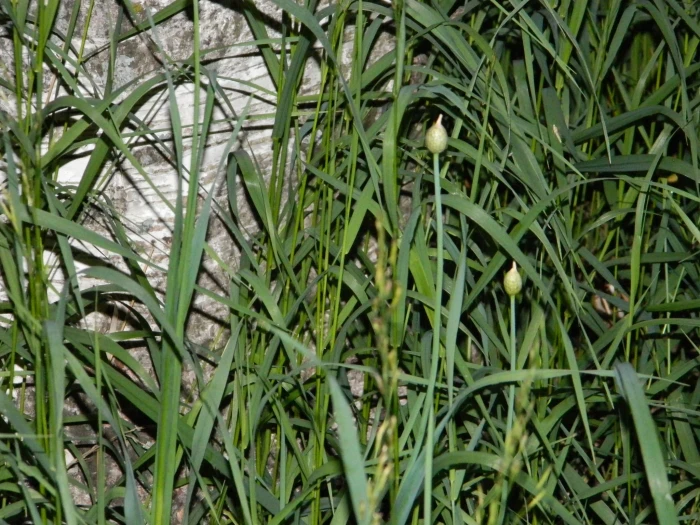

Виктория Билоус
CC BY 4.0

Image By:
Виктория Билоус
Recorded By:
Copyright:
CC BY 4.0
Copyright Notice:
Photo by: Виктория Билоус | License Type: CC BY 4.0 | License URL: http://creativecommons.org/licenses/by/4.0/ | Rights Holder: Виктория Билоус | Publisher: iNaturalist | Date Created: 2022-06-23T23:05:28-07:00 |






Summary
Allium obliquum, commonly known as lop-sided onion or twisted-leaf onion, is a perennial herb native to a wide range of habitats including meadows, rocky slopes, and riverbanks from Romania to Mongolia. It can grow up to 40 inches tall and is characterized by its unique spherical umbels of star-shaped, yellow flowers that bloom in early to mid-summer. The leaves are flat and typically shorter than the scape, which is round in cross-section and can give the plant a somewhat twisted appearance. The twisted-leaf onion is particularly noted for its ornamental value, with its distinctive flower shape and color providing visual interest in garden settings.
In cultivation, Allium obliquum is appreciated for its ease of maintenance and its ability to thrive in a variety of garden conditions. It is often used in borders, rock gardens, and as a part of naturalistic plantings. This species prefers well-drained soils and full sun, but can tolerate light shade. It is generally free from serious pests and diseases, making it a resilient choice for gardeners. While it is not aggressive, it can naturalize by self-seeding under optimal conditions. Gardeners should be aware that all parts of the plant have a strong onion scent when crushed.CC BY-SA 4.0
In cultivation, Allium obliquum is appreciated for its ease of maintenance and its ability to thrive in a variety of garden conditions. It is often used in borders, rock gardens, and as a part of naturalistic plantings. This species prefers well-drained soils and full sun, but can tolerate light shade. It is generally free from serious pests and diseases, making it a resilient choice for gardeners. While it is not aggressive, it can naturalize by self-seeding under optimal conditions. Gardeners should be aware that all parts of the plant have a strong onion scent when crushed.CC BY-SA 4.0
Plant Description
- Plant Type: Bulb
- Height: 2-3 feet
- Width: 0.6-1 feet
- Growth Rate: Moderate
- Flower Color: Yellow
- Flowering Season: Summer
- Leaf Retention: Deciduous
Growth Requirements
- Sun: Full Sun, Part Shade
- Drainage: Fast, Medium
Common Uses
Border Plant, Butterfly Garden, Deer Resistant, Drought Tolerant, Groundcover, Low Maintenance, Rabbit Resistant
Natural Habitat
Meadows, rocky slopes, and riverbanks from Romania to Mongolia
Other Names
Common Names: Slanting Onion
Scientific Names: Allium obliquum, Allium exaltatum, Allium exaltatum, Allium luteum, Allium porrum, Allium ramosum, Camarilla obliqua, Cepa obliqua, Geboscon obliquum
GBIF Accepted Name: Allium obliquum