Wolf’s-Bane
/
(Aconitum lycoctonum)
Wolf’s-Bane (Aconitum lycoctonum)
/


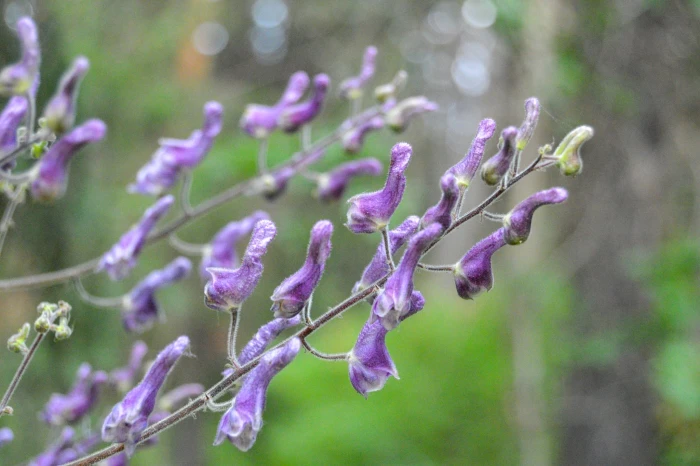

Ирина Хохрякова
CC BY 4.0

Image By:
Ирина Хохрякова
Recorded By:
Copyright:
CC BY 4.0
Copyright Notice:
Photo by: Ирина Хохрякова | License Type: CC BY 4.0 | License URL: http://creativecommons.org/licenses/by/4.0/ | Rights Holder: Ирина Хохрякова | Publisher: iNaturalist | Date Created: 2023-07-08T17:51:49-07:00 |






Summary
Aconitum lycoctonum, commonly known as wolf’s-bane or northern wolf’s-bane, is an herbaceous perennial plant native to mountain meadows, forest clearings, and damp, grassy areas of Europe and northern Asia, extending from lowland regions to subalpine zones. It typically grows up to 3 feet tall and features deeply palmately lobed leaves that are green in color. The plant produces inflorescences of hooded flowers that can be dark violet or pale yellow, blooming from mid to late summer. The flowers are showy and are primarily pollinated by long-tongued bumblebees.
Wolf’s-bane is known for its striking flowers and is sometimes cultivated in gardens for its ornamental value, although it must be handled with care due to its toxic alkaloids. It prefers moist, well-drained soils in part shade to full shade conditions. In cultivation, it requires consistent moisture and should not be allowed to dry out. It is not commonly used due to its toxicity, but it can be an interesting addition to woodland gardens or naturalized areas where its ecological role in supporting pollinators can be appreciated. Gardeners should be aware of its highly toxic nature, as all parts of the plant contain poisonous alkaloids that can be lethal if ingested. There are no popular cultivars due to its toxic properties, and it is not recommended for gardens with children or pets.CC BY-SA 4.0
Wolf’s-bane is known for its striking flowers and is sometimes cultivated in gardens for its ornamental value, although it must be handled with care due to its toxic alkaloids. It prefers moist, well-drained soils in part shade to full shade conditions. In cultivation, it requires consistent moisture and should not be allowed to dry out. It is not commonly used due to its toxicity, but it can be an interesting addition to woodland gardens or naturalized areas where its ecological role in supporting pollinators can be appreciated. Gardeners should be aware of its highly toxic nature, as all parts of the plant contain poisonous alkaloids that can be lethal if ingested. There are no popular cultivars due to its toxic properties, and it is not recommended for gardens with children or pets.CC BY-SA 4.0
Plant Description
- Plant Type: Herb
- Height: 3-7 feet
- Width: 2-3 feet
- Growth Rate: Moderate
- Flower Color: White, Yellow
- Flowering Season: Summer
- Leaf Retention: Deciduous
Growth Requirements
- Sun: Full Sun, Part Shade
- Drainage: Medium, Slow
Common Uses
Border Plant
Natural Habitat
Mountain meadows, forest clearings, and damp, grassy areas in Europe and northern Asia
Other Names
Common Names: Yellow Monkshood, Northern Wolfsbane
Scientific Names: Aconitum lycoctonum, Aconitum artophonum, Aconitum carpaticum, Aconitum lycoctonum, Aconitum lycoctonum subsp. carpaticum, Aconitum lycoctonum subsp. pyrenaicum, Aconitum lycoctonum var. caeruleum, Aconitum lycoctonum var. carpaticum, Aconitum lycoctonum var. clusianum, Aconitum lycoctonum var. cynoctonum
GBIF Accepted Name: Aconitum lycoctonum